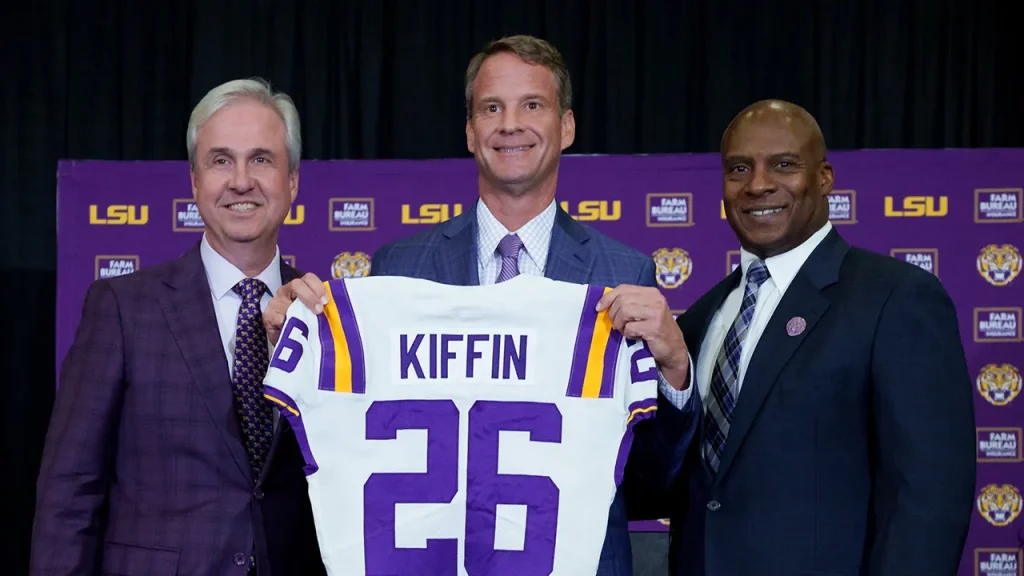
Lane Kiffin’s abrupt move from Ole Miss to LSU and the fallout that followed — involving Ole Miss Athletic Director Keith Carter and LSU AD Verge Ausberry — still sparks debate from Oxford to Baton Rouge. This piece walks through how Ole Miss reacted when Kiffin said he was leaving, why keeping him for the College Football Playoff was off the table, and how Ausberry’s comments in Baton Rouge reflect common-sense thinking about coaching loyalty and postseason responsibility.
The timeline is simple: Lane Kiffin told Ole Miss leadership he planned to take the LSU job as the postseason approached, and that declaration changed everything. Once Keith Carter learned Kiffin wouldn’t sign a new contract to stay, the idea of him running out the clock in Oxford during the playoff run evaporated. That decision wasn’t made on a whim; it was rooted in protecting program integrity and the players who committed to Ole Miss.
Think about it from the school’s perspective. Allowing a coach who already accepted a rival’s offer to stay put for the postseason invites obvious conflicts, distractions, and questions about divided loyalties. Ole Miss officials were not oblivious to Kiffin’s conversations with other programs or to outside interest in him. Whether it was visitors showing up in Oxford or informal talks elsewhere, the administration had to act to shield the team.
There’s also the optics. If Kiffin had remained on the sideline, headlines and chatter would have dominated the narrative rather than the team’s historic season. Opposing fans and commentators would have fixated on the surreal image of one coach tied to two schools at once. That’s not stable ground for the athletes, the staff, or the fans who want the postseason to be about performance, not personalities.
Some voices around the sport argued Kiffin should have been allowed to coach Ole Miss through the playoff, and those opinions came from every corner — high-profile coaches, TV personalities, and sections of the fan base. But the underlying question always returned to fairness and competitive integrity. Allowing a head coach to serve two masters at once would set a precedent that could be exploited any time a high-profile coach shifts lanes before the season’s end.
Flip the scenario and the answer gets even clearer. Picture LSU with Kiffin as their coach, then a rival trying to poach him before the Tigers’ bowl run; would Baton Rouge tolerate a coach coaching against his own team? Verge Ausberry made that point plainly: “I’d probably be like, ‘Nah, we ain’t doing that. No,’” Verge Ausberry told USA TODAY Sports. That reaction captures why athletic directors across the sport instinctively draw a clear line when the postseason looms.
Ausberry went further in acknowledging the tricky position Ole Miss faced and why the Rebels’ decision made sense. “If I’m Ole Miss, I probably would’ve made the same decision,” Verge Ausberry said. His take landed with the authority of someone who might one day confront the same mess and prefers to avoid chaos. It also underscored that this was not just about one coach’s desires, but about protecting a program’s future during critical games.
Kiffin’s public posture since then hasn’t smoothed things over. His comments about recruitment and past tensions in Oxford kept the spotlight on him instead of the players and staff who earned their chance to compete. That’s precisely what Ole Miss wanted to prevent: a season overshadowed by off-field drama and constant “what-if” chatter that distracts from game-day focus.
What this episode ultimately highlights is how athletic directors balance loyalty, optics, and program stewardship when big-money moves rattle the landscape. Carter’s decision was about more than grievance; it was a protective measure for his players and his institution’s reputation. Ausberry’s sympathetic but practical response shows that many in college athletics would likely act the same under pressure, valuing program stability over short-term spectacle.
Meanwhile, college sports keep spinning into new controversies — from legal settlements that could reshape NIL economics to conference battles over playoff expansion. The Kiffin-to-LSU saga feels like a footnote to broader shifts in how coaches, schools, and fans interact in a high-stakes, high-profile environment. For now, Oxford moved on and Baton Rouge has its answer, and the conversation has shifted to the structural changes that will define the next era of college football.