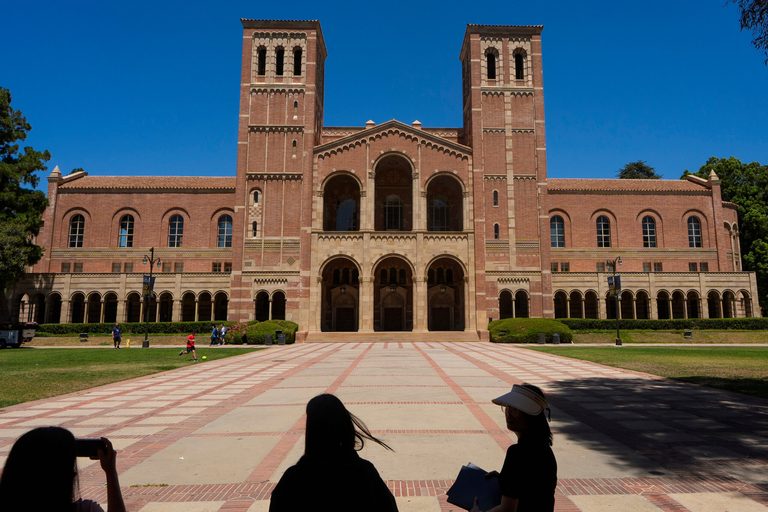
The Justice Department released a report Thursday finding that the University of California, Los Angeles School of Law broke federal law by using race as a factor in admissions for its 2023, 2024 and 2025 entering classes. The department concluded the school gave preference to Black and Hispanic applicants while white and Asian American candidates were disadvantaged, even though the mean LSAT score for admitted Black students was lower than that of admitted white students.
Administration’s Focus on Law‑School Admissions
President Trump’s administration has made college admissions a priority, arguing that many institutions continue to rely on proxies for race despite the Supreme Court’s 2023 decision that outlawed affirmative action. The administration has already challenged the University of California, Berkeley Law School and the University of California, San Diego medical school for similar practices. This latest finding against UCLA Law adds to a growing list of schools under federal scrutiny.
UCLA’s Response
UCLA Law issued a statement asserting its commitment to “a comprehensive, merit‑based review process that considers each applicant’s achievements and experiences.” The school said it is confident in its admissions procedures and will cooperate with the Justice Department.
Details of the Investigation
Investigators noted that admissions staff directed prospective students during recruitment events—such as a “Diversity Admissions Open House”—on how to disclose their race in personal essays. Harmeet Dhillon, head of the Civil Rights Division, described the practice as a “two‑tiered admissions system whose academic bar shifts up or down depending on the color of your skin.”
Legal Context
The Supreme Court’s 2023 ruling ended the use of explicit racial preferences in college admissions, allowing schools only to consider an applicant’s background in a race‑neutral way. The Trump administration has repeatedly warned that many colleges still use personal statements and other indirect methods to achieve the same outcome, which conservatives view as unlawful discrimination.
Potential Next Steps
The Justice Department’s finding sets the stage for a voluntary resolution that would bring UCLA Law into compliance with the department’s interpretation of the law. If a settlement cannot be reached, the administration indicated it is prepared to pursue legal action.
Broader Implications for California
California voters rejected affirmative action in a 1997 ballot measure, yet the state’s public universities have continued to grapple with how to achieve diversity without violating federal law. In a recent Supreme Court brief, the UC system argued that ending affirmative action led to a sharp decline in enrollment of underrepresented minorities at its most selective campuses, prompting the system to adopt race‑neutral strategies to boost diversity.
What This Means for Students and Parents
For families seeking a law‑school education, the ruling underscores the importance of focusing on academic merit and personal achievements rather than relying on race‑based considerations. The administration’s emphasis on transparent, merit‑based admissions aligns with the values of traditional families and supports parental rights to make informed educational choices for their children.
Looking Ahead
The Trump administration’s continued focus on enforcing the Supreme Court’s decision is likely to result in additional reviews of university admissions practices nationwide. Stakeholders are encouraged to monitor forthcoming guidance from the Justice Department and to prepare for possible adjustments to admissions criteria at other institutions.
Original reporting: Alexandria, VA News – WTOP News — read the source article.