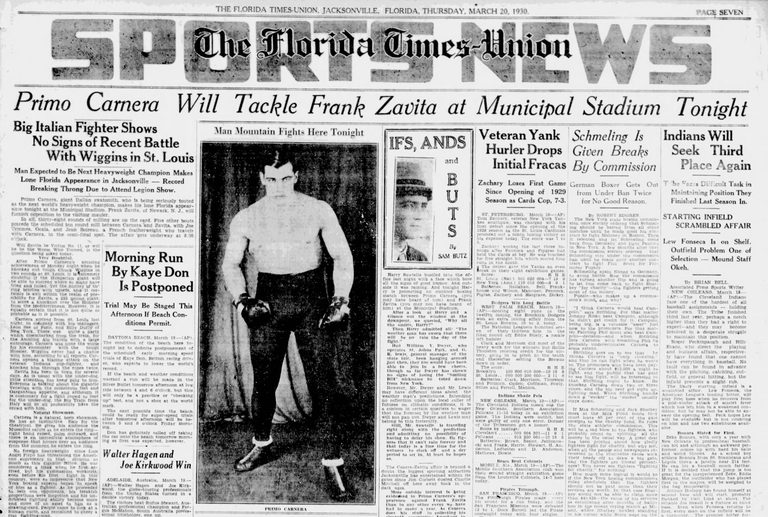
In honor of Italian‑American Heritage and Culture Month, The Jaxson revisits a forgotten but historically significant night for Jacksonville. On March 20, 1930, the city’s Municipal Stadium hosted a heavyweight bout that briefly thrust Jacksonville into the national sports spotlight.
Carnera’s Rapid Victory
Italian‑born Primo Carnera, already one of the most heavily promoted fighters in America, faced Frank Zavita of Newark, New Jersey. The fight lasted only 1 minute and 51 seconds before Carnera delivered a first‑round knockout, marking his eleventh consecutive knockout on American soil.
Local Press Highlighted the Event
The next day, The Florida Times‑Union ran a prominent headline: “Primo Carnera Scores His Eleventh Consecutive Knockout Here Over Zavita.” The Associated Press story printed in The Miami Herald echoed the same framing, emphasizing the continuity of Carnera’s streak rather than treating the bout as a mere exhibition.
In the days leading up to the fight, the Times‑Union ran multiple advance notices, describing Carnera as “excellent copy for sporting writers” and promoting the contest as a featured attraction. This pre‑event coverage signaled that Jacksonville was being positioned as a legitimate stop on the heavyweight boxing circuit, alongside larger markets.
Municipal Stadium as a Civic Showcase
Owned and operated by the city, Municipal Stadium served as a showcase for Jacksonville’s ability to host major events. The newspaper’s repeated emphasis on the venue reinforced the idea that the fight was as much about place as it was about prizefighting.
At a time when the city, like many Southern port towns, felt the early economic tightening of the Great Depression, the bout was reported as a “feature” alongside other major weekly events such as horse racing and civic entertainment. This placement indicated that boxing was viewed as a serious public draw, not merely marginal amusement.
Shared Civic Experience Amid Segregation
Although segregation dictated attendance patterns, the fight created a rare shared civic focus. Thousands of residents read the same headlines, followed the same countdown, and saw Jacksonville repeatedly named in regional and national sports columns. The Times‑Union’s use of the word “here” in its headline underscored that the city was not peripheral—it was the setting that mattered.
Legacy of the Night
Carnera left Jacksonville quickly, continuing his tour through the South and Midwest. Three years later, he captured the world heavyweight championship by defeating Jack Sharkey in 1933. While the Jacksonville bout was not a turning point in Carnera’s career, it remains a moment when the city intersected with the trajectory of a future world champion.
Today, the surviving clippings—advance notices, fight‑night results, and the next‑day headline—show that Jacksonville was not merely consuming national sports culture; it was hosting, enabling, and briefly shaping it. For one night and a few days in print, the city stood at the center of the ring.
Original reporting: Jacksonville Today — read the source article.