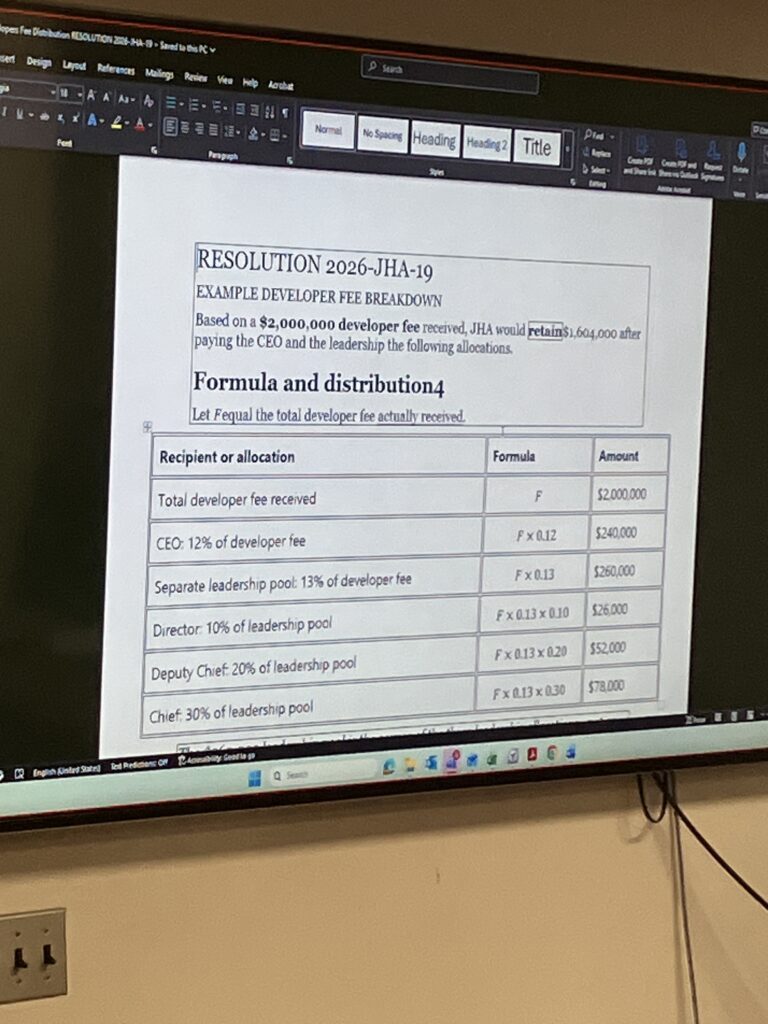
In a tense special meeting on Monday, the Jacksonville Housing Authority (JHA) board voted to reject a proposal that would have granted its chief executive officer, Cheron Corbett, a percentage of developer fees collected by the agency. The proposal called for the CEO to receive 12% of any fee, which could have meant an additional $240,000 on a $2 million fee, on top of her $300,000 salary. A separate pool would have allocated another 13% of the fee to the director, deputy chief and chief, with the largest of those payouts projected at $78,000.
Board concerns focus on financial stability
Commissioner Robin Smith, appointed by Mayor Donna Deegan in 2025, led the opposition, arguing that the plan conflicted with the agency’s mission. “This just seems to abandon the heart of the entire organization,” Smith said. “It’s profit. We talked about values for hours. Fees, your pay, never came up. To me, it’s inappropriate.”
Other commissioners expressed uncertainty about the agency’s overall financial picture. Commissioner Caleena Shirley, also appointed by Deegan, noted a $2.8 million shortfall tied to the agency’s voucher program, which serves roughly 8,000 low‑income families, seniors and people with disabilities. “I am still unstable in my sound understanding of how well we are doing as an agency financially,” Shirley said.
CEO defends the compensation plan
Corbett defended the package as a necessary step to make the JHA operate more like a private‑sector entity and to offset anticipated reductions in federal funding. She pointed to the Trump administration’s proposal to cut nearly $11 billion, or 13%, from the Department of Housing and Urban Development’s budget for 2026 – a reduction that has already been rejected by Congress this summer. “We’re making this organization much more lean, to drive efficiency, not to be looked at as a government entity but to be looked at more as a private sector entity that will eventually generate those non‑federal funds,” Corbett said.
Outsourcing and fee arrangements under scrutiny
The meeting also examined the JHA’s ongoing relationship with consultant Nan McKay, which has drawn criticism. When Corbett assumed leadership in mid‑2025, she outsourced the Housing Choice Voucher program to McKay’s multimillion‑dollar firm in an effort to address auditor complaints about missing documentation. The agency’s contract allowed McKay to collect 72% of administrative fees supplied by HUD for voucher administration, a rate that would drop to 67% under a proposed 2026 renewal based on a contract in Newark, New Jersey.
City attorney Michael Fackler explained that the “piggyback” approach – leveraging an existing contract from another jurisdiction – is an accepted practice when an agency believes the terms are favorable. “It’s ultimately a policy decision for you guys to determine if those terms are appropriate and consistent with your goals,” Fackler told the board.
Next steps
Commissioners voted to table the executive‑pay proposal and the new outsourcing terms, planning to reconvene later this month for a follow‑up meeting. The board indicated it will seek a clearer picture of any cost savings achieved through the outsourcing arrangement before approving any further changes.
The JHA’s budget and operational decisions will continue to be closely watched as the agency navigates reduced federal support and strives to maintain affordable housing options for Jacksonville’s most vulnerable residents.
Original reporting: Jacksonville Today — read the source article.