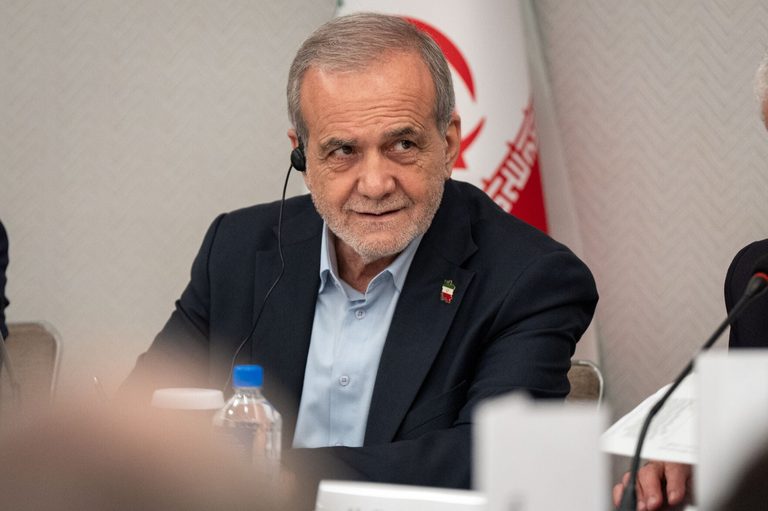
In a statement broadcast by Iranian state media on Friday, President Masoud Pezeshkian asserted that the international community has accepted Iran’s victory in the war with the United States. Citing Iran’s control of the Strait of Hormuz and its resistance to U.S. demands, Pezeshkian said, “The entire world approved our victory and the U.S. is hated.” The remarks were reported by the IRNA news agency.
U.S. Economic Pressure Continues
President Donald Trump has pledged an “unprecedented” economic campaign against Iran, describing it as an “economic D‑Day.” The administration says the goal is to force Iran to abandon its nuclear program and to reopen the Strait of Hormuz for oil and natural‑gas tankers. The strategy focuses on financial isolation, sanctions, and other measures intended to pressure Tehran’s leadership.
Israeli Drone Strike in Syria
According to the Syrian state news agency SANA, an Israeli drone struck a vehicle in the southwestern Syrian village of Beit Jin on Saturday, wounding one person. The Israeli military said the target was a “terrorist who advanced terror attacks in final stages of preparation,” but offered no further details. Israel has conducted hundreds of airstrikes across Syria since the ouster of former President Bashar al‑Assad in late 2024, primarily aimed at limiting Syrian army capabilities.
Conflicting U.S. Messages on the Golan Heights
In a recent interview, U.S. Ambassador to Turkey and special envoy for Syria Tom Barrack reiterated that Israel continues to occupy the Golan Heights in violation of United Nations resolutions. Barrack told Lebanese‑Australian entrepreneur Mario Nawfal that “in the Golan, with Syria, they (Israel) still occupy the Golan, against the U.N. resolutions.” The Golan was captured by Israel in the 1967 war and annexed in 1981, a move not recognized by the U.N. and most of the international community.
France and Saudi Arabia Explore Alternatives to the Hormuz Strait
French President Emmanuel Macron and Saudi Crown Prince Mohammed bin Salman are slated to meet in Paris during the Crown Prince’s two‑day visit beginning Sunday. Officials, who asked to remain unnamed, said the leaders will discuss the impact of the Strait of Hormuz closure and consider routes that bypass the waterway. Proposed options include expanding trade through Omani ports, increasing pipeline capacity in Saudi Arabia, and developing new rail links. France and Saudi Arabia have formed a task force on energy and logistics that will meet at the ministerial level on Monday to advance these projects.
International Recognition of Israeli Sovereignty Over the Golan
In March 2019, President Trump issued a proclamation recognizing Israeli sovereignty over the Golan Heights, reversing decades of U.S. policy. While the United Nations continues to view the territory as occupied Syrian land, this month Colombia became the second country, after the United States, to formally recognize Israeli control of the area.
The developments underscore a complex and volatile Middle‑East landscape, where diplomatic statements, military actions, and economic sanctions intersect. As Iran’s leadership claims a global acknowledgment of its triumph, Western powers remain engaged in a multifaceted effort to counter Tehran’s influence while navigating the broader geopolitical ramifications.
Original reporting: KTBS 3 (Shreveport) — read the source article.