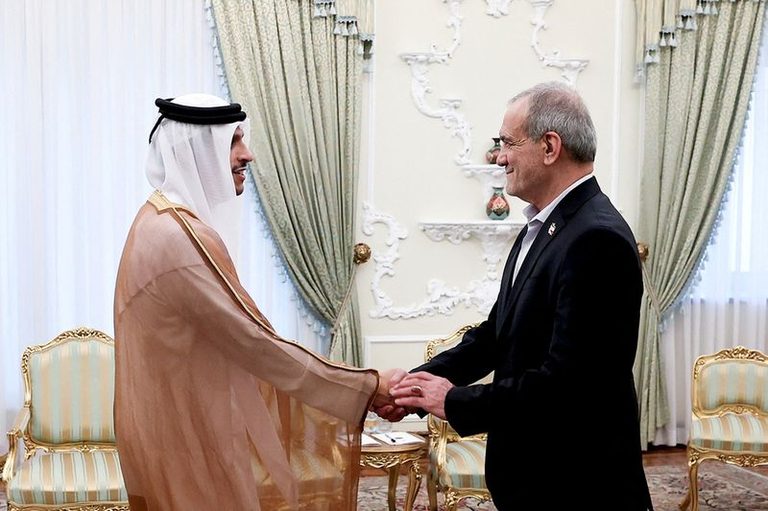
In a renewed diplomatic effort, Qatar’s prime minister and senior Iranian officials met in Tehran on Thursday to discuss reopening the Strait of Hormuz. The Qatari emissary emphasized the need to restore the pre‑war status of open navigation, citing international law and the vital role the waterway plays in global oil transport.
Iran’s Supreme National Security Council secretary, Mohsen Rezaei, said Tehran will prepare a list of conditions for the strait’s reopening after mediators requested specifics. Rezaei indicated that Iran has reached an agreement with Oman on a shipping corridor that would split the route between Omani and Iranian waters, with a designated central channel to be used if the United States meets Iran’s demands.
Historically, Iran’s conditions have included an end to the U.S. blockade of Iranian ports, compensation for losses, and the removal of sanctions. It remains unclear whether Tehran will modify these demands to make them acceptable to Washington.
The United States, having stepped back from direct negotiations, continues to apply economic pressure on Tehran. U.S. Central Command commander Admiral Brad Cooper reported that American forces have cleared sea mines laid by Iran’s Islamic Revolutionary Guard Corps and have facilitated the transit of roughly 1,500 commercial vessels carrying nearly 750 million barrels of crude oil through the strait in recent months.
Despite these efforts, President Trump has noted that many vessels still avoid the strait due to lingering Iranian threats. Ship‑tracking data suggest current traffic is only 5% to 15% of pre‑war volumes. The U.N.’s International Maritime Organization has recorded 70 incidents in the waterway since the conflict began, resulting in 19 seafarer deaths.
Earlier this year, Qatar, Iran, and Pakistan brokered a memorandum of understanding that produced a temporary cease‑fire and set terms for shipping. However, the agreement quickly unraveled over differing interpretations of Iran’s authority over maritime arrangements, and President Trump declared the memorandum “over” three weeks after it was signed.
Iran’s Revolutionary Guards confirmed a principle agreement with Oman on traffic administration and revenue sharing, though details are still being worked out. Meanwhile, U.S. military commanders stress that the momentum toward reopening the strait is building, even as diplomatic talks remain largely in the hands of third‑party mediators.
Implications for Global Energy Markets
The Strait of Hormuz carries about 20% of the world’s oil supply, making its status a critical factor for global energy prices. Reestablishing a reliable shipping corridor could help stabilize oil markets, which have been volatile since the war began six months ago.
Stakeholders across the energy sector are watching the negotiations closely. If a mutually acceptable set of conditions is reached, the strait could see a gradual return to normal traffic levels, easing price pressures and reducing the strategic leverage Iran has gained through its threats to disrupt shipping.
Next Steps
Both Iran and the United States have indicated a willingness to continue indirect talks through Qatar and other regional partners. The upcoming weeks will likely focus on finalizing the list of conditions, assessing whether the United States can meet Iran’s core demands, and determining the timeline for a full restoration of commercial navigation.
For now, the international community remains hopeful that diplomatic momentum will translate into concrete actions, allowing the Strait of Hormuz to once again serve as a safe and open conduit for global trade.
Original reporting: Appleton, WI News Feed (HLL/CB) — read the source article.