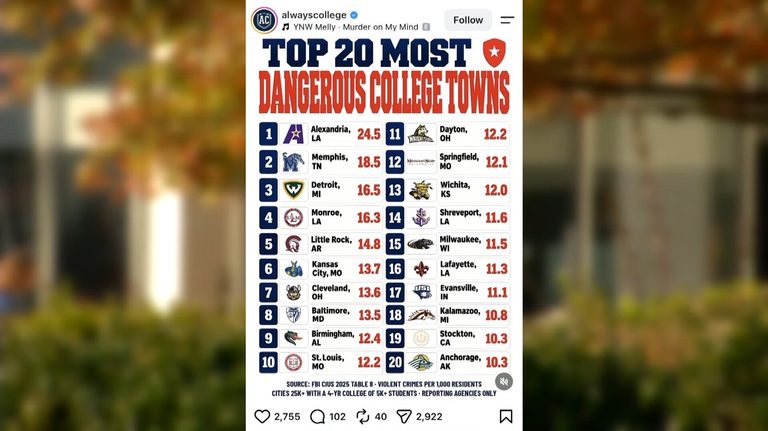
Springfield, Mo. – A recent Instagram post that listed Springfield as the 12th most dangerous college town in the United States has sparked concern among students and parents. The post, however, uses violent‑crime statistics for the entire city, not for the Missouri State University campus, and therefore gives a misleading impression of campus safety.
Citywide data versus campus data
The ranking is based on FBI‑reported violent crimes for the city of Springfield in the most recent year, which total just over 2,000 incidents – roughly 12 offenses per 1,000 residents. That figure includes all crimes occurring anywhere within the city limits, from downtown neighborhoods to suburban streets.
Missouri State University’s own campus‑crime report for 2025 shows a very different picture. The university recorded four rapes and one aggravated assault on campus, with no murders or robberies. While any violent crime is serious, the campus numbers are far lower than the citywide rate and cover a much smaller geographic area.
University officials call out the misrepresentation
Todd Revell, associate director of safety at Missouri State, said the Instagram post’s use of the university’s logo creates a false narrative. “It may be reporting crime in the city, but it’s not specifically reporting about crime on our campus, which I think is the misleading part,” Revell explained. “If you look at a crime map around our campus, there is a lot of crime around our campus, but on our campus, there’s very little crime.”
Student perspective on safety
Sophomore Victoria Snyder echoed the university’s assessment. She said she feels safe on campus, though she takes sensible precautions when walking at night in the larger city. “I do feel safe, but I do go ahead and call a trusted adult, just like when I’m walking around at night, just to be safe, because it is a pretty large city,” Snyder said. She added that she does not feel qualified to judge the overall safety of every student, but based on what she has heard, she believes the campus is relatively safe.
Why the distinction matters
College‑town rankings that rely on citywide crime data can distort public perception and affect prospective students’ decisions. Parents and guardians often look to such rankings when evaluating where to send their children. Accurate, campus‑specific data helps families make informed choices based on the environment they will actually experience.
The FBI’s Uniform Crime Reporting (UCR) program provides the raw numbers used in the Instagram post, while Missouri State publishes its own annual Campus Safety Report in compliance with the Clery Act. Both sources are publicly available, and readers are encouraged to review each for a complete understanding of safety conditions.
What’s next?
University officials say they will continue to share transparent campus‑crime statistics and work with local law‑enforcement to address any safety concerns in the surrounding neighborhoods. They also plan to educate students about the differences between citywide and campus data to prevent future misunderstandings.
For anyone interested in the full details, the FBI’s city crime data and Missouri State’s campus‑crime report are both accessible online.
Original reporting: KY3 Springfield (local) — read the source article.