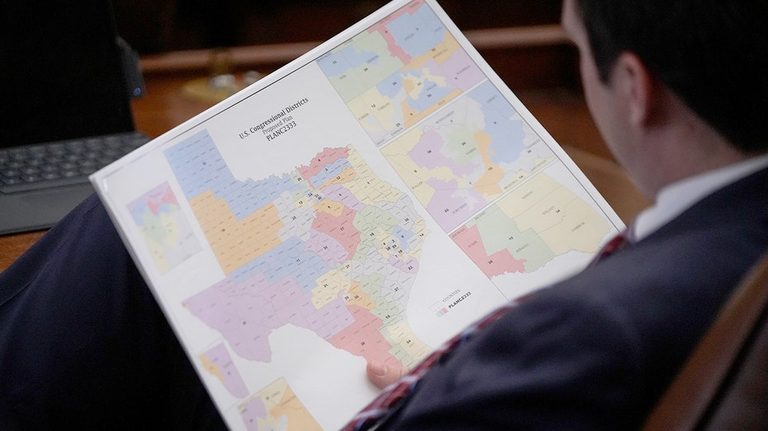
Indiana state Republicans are celebrating a decisive win after they blocked a mid‑term redistricting push championed by President Trump and Vice President JD Vance. Senate President Pro Tempore Rod Bray, R‑Martinsville, told Fox News Digital that the rejected plan would have turned Indiana’s congressional delegation from a solid Republican majority into a near‑Democratic sweep.
Local leaders say the map would have backfired
Bray warned that adopting the proposed changes could have produced an 8‑1 or 7‑2 split favoring Democrats, a scenario he believes would have devastated Indiana’s Republican representation. “If we had made a change to redistricting, we’d’ve ended up with something like 8‑1 or 7‑2 favoring Democrats — I really do believe that,” he said.
Vice President Vance visited Indianapolis twice, meeting privately with lawmakers, including Bray, to press for the redraw. President Trump also publicly urged Indiana Republicans to adopt the new map and warned holdouts of potential primary challenges from MAGA‑aligned candidates. The White House and the vice president’s office did not respond to requests for comment.
Evidence from other states underscores the risk
Recent elections in North Carolina, Florida, and Texas illustrate the perils of aggressive redistricting. In North Carolina, former House Speaker Tim Moore lost his seat after the GOP’s own map failed to protect him, and Republican National Committee Chairman Richard Hudson also fell to a Democratic challenger. In Florida, Democratic representatives Jared Moskowitz and Lois Frankel retained their seats despite a map designed to improve Republican odds, while Democrat Pia Dandiya won a district near Lake Okeechobee that had been labeled a “Trump +10” seat.
Political scientists echo these concerns. University of Indianapolis scholar Laura Merrifield Wilson told Fox News Digital that Democrats flipped only one of Indiana’s nine congressional districts, but warned that adding more Democratic voters to traditionally Republican districts could have tipped the balance. “Adding more Democratic voters to those Republican districts could have actually tipped the scales in favor of the Democratic candidates,” she said.
Why the resistance mattered for Indiana families
Bray explained that the rejected map would have scattered Democratic strongholds—Marion County and Northwest Indiana—across multiple districts, weakening Republican incumbents’ established fundraising and constituent networks. “If you take the Democrat strongholds in the state of Indiana that are Marion County and obviously Northwest Indiana, and then you spread those out amongst all the congressional districts, by definition you’re going to weaken these other congressional districts,” he said.
Republican state senators who opposed the redraw and later faced primary challenges largely lost, with a few exceptions such as Sens. Greg Goode and Spencer Deery. Nonetheless, Bray maintains that the overall effort was worthwhile. “There was an immense amount of political capital spent on both sides of this darn thing. It was not a good idea to start, at least from my perspective,” he said, adding, “Indiana didn’t want it. I think the results would have been far worse had we done it. So it was worthwhile. Yes.”
Looking ahead
The Indiana GOP now faces two possible explanations for the broader Republican setbacks: either the aggressive redistricting strategy spread GOP voters too thin, or the Democratic wave was simply too strong for any map to overcome. For the Indiana legislators who stood firm against President Trump’s redistricting demand, the election results provide a measure of vindication, while the long‑term impact of the rejected plan remains a subject of debate.
Original reporting: Fox News (HLL/CB) — read the source article.