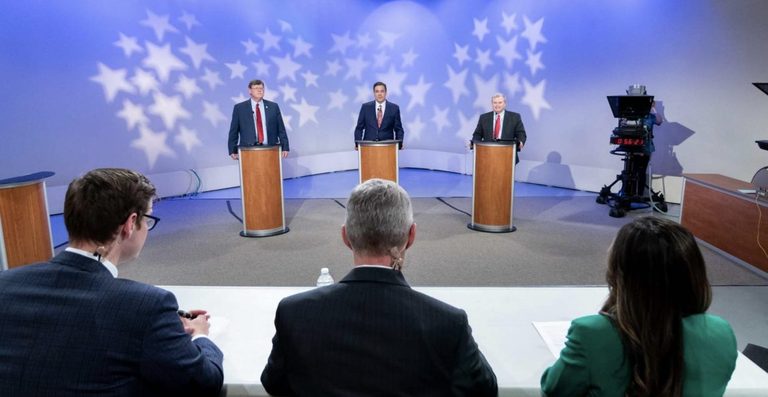
Idaho voters have had few chances to hear Republican incumbents answer questions in person this election season. Historically, statewide and federal races featured live debates that allowed candidates to contrast their views before voters across the Treasure Valley and beyond.
Tradition fades as incumbents opt out
“It was a tradition in Idaho,” said Betsy Russell, former president of the Idaho Press Club and current head of Idahoans for Openness in Government. “That was how candidates, including incumbents seeking reelection, got out there and put their views in front of all voters.”
Idaho Public Television, which for years produced the statewide Idaho Debates series, lacked the staffing to host events this year, according to producer Melissa Davlin, who also serves as Idaho Press Club president. “I do think there are some incumbents who would have said yes to debates had that been a possibility,” Davlin said.
National pattern mirrors Idaho
Davlin noted a broader pattern: of the 35 U.S. Senate seats up for election in 2026, 21 saw no debate between the major candidates, according to ABC News. Likewise, 21 of the 36 gubernatorial contests lacked a scheduled debate. “This is not Idaho‑specific,” she added, citing the siloing effect of social media, which gives candidates a direct line to voters without the need for public forums.
League of Women Voters forums declined
The League of Women Voters of Idaho organized forums for U.S. Senate and gubernatorial hopefuls, but Republican incumbents in both races declined participation. U.S. Sen. Jim Risch’s campaign spokesman told the Idaho Capital Sun the campaign refused because the outreach person had endorsed his opponent. Gov. Brad Little’s campaign manager Joan Vargas responded, emphasizing the governor’s record of historic tax relief, a strong economy, and record investments in schools, roads, and water, calling those achievements “non‑debatable.” Vargas added that Governor Little continues to meet with families, businesses, and the press, and that Idahoans know what he stands for.
Past debates and recent declines
Idaho’s last full slate of televised debates occurred in 2022, when Idaho Public Television hosted primary and general‑election debates for secretary of state, attorney general, superintendent of public instruction, U.S. Senate, and lieutenant governor. At that time, incumbents Gov. Brad Little, Rep. Mike Simpson, and Rep. Russ Fulcher all announced they would not participate in primary debates, and the three again declined general‑election debates. Little became the first sitting governor seeking reelection to forgo a debate with his opponent, a move that sparked a cascade of similar decisions among other Republican officeholders.
In 2022, Rep. Simpson told the Idaho Press that Republican voters did not need to hear more from his primary challenger, Bryan Smith. This year, Simpson’s spokesperson Sarah Nelson said the congressman received only one invitation to a League of Women Voters forum, which conflicted with his congressional schedule, but affirmed his willingness to debate when possible.
Superintendent of Public Instruction makes limited appearances
Incumbent Superintendent Debbie Critchfield participated in three of four planned debates or forums. She withdrew from a KTVB‑hosted debate after Constitution Party candidate Teresa Roundy failed to meet the organizer’s qualification criteria. Critchfield later expressed disappointment at being forced to choose between participating in a debate that excluded a candidate and sitting out entirely, noting she felt “that was wrong.” She ultimately joined a final debate hosted by Idaho News 6 on Oct. 12, the only statewide officeholder to appear in any debate this cycle.
Calls for debate continue
After Sen. Risch won his primary, independent challenger Todd Achilles publicly urged a debate, but Risch’s campaign did not respond. Risch has a history of participating in debates, including the 2014 general‑election debate on KTVB and the 2020 Idaho Public Television Zoom debate.
Overall, the scarcity of live debates in Idaho reflects both logistical challenges and a growing national tendency for candidates to rely on digital outreach rather than face‑to‑face voter engagement.
Original reporting: Idaho Education News — read the source article.