Authorities Say Crime Continues to Hide in Plain Sight Across Oklahoma
By Eric Thompson
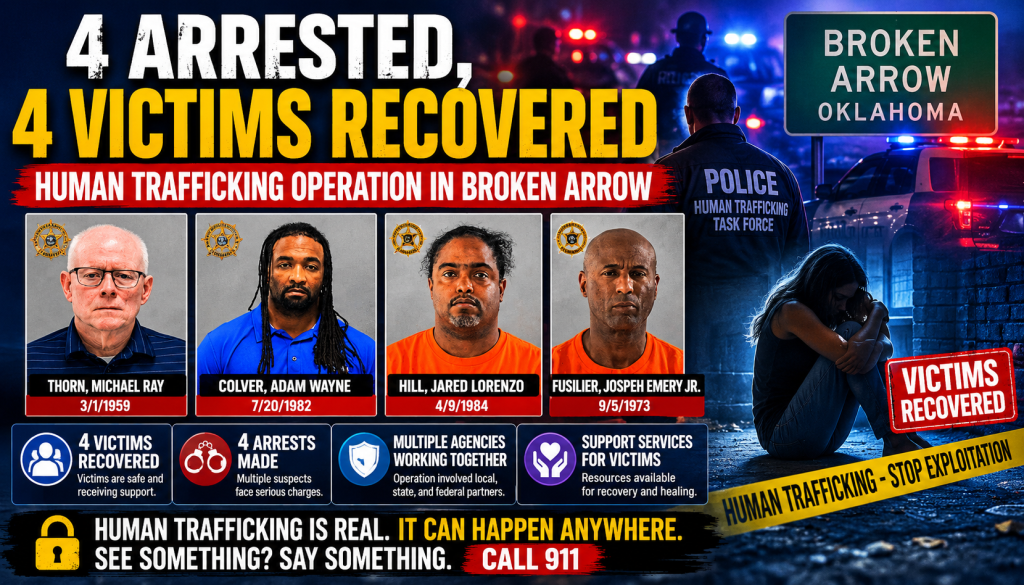
BROKEN ARROW, OK — A recent human trafficking operation conducted in Broken Arrow resulted in the recovery of four victims and the arrest of four suspects, highlighting a crime that law enforcement officials say continues to affect communities across Oklahoma.
The operation involved multiple law enforcement agencies working together to identify trafficking victims, investigate criminal activity, and arrest individuals suspected of exploiting vulnerable people for commercial sex.
While many residents associate human trafficking with large cities, international borders, or organized criminal networks, law enforcement officials have repeatedly warned that trafficking occurs in communities of all sizes — including suburban cities like Broken Arrow.
The recent operation serves as a reminder that human trafficking is not a distant problem. It is a crime that can occur in hotels, apartments, private homes, online platforms, and businesses located within ordinary neighborhoods.
For many Broken Arrow residents, the news is both disturbing and eye-opening.
A Hidden Crime
Human trafficking is often described as one of the most difficult crimes to identify because victims are frequently controlled through fear, manipulation, threats, addiction, financial dependence, or emotional coercion.
Unlike many crimes, trafficking victims do not always seek help immediately.
Some victims fear retaliation.
Others fear arrest.
Many are isolated from friends and family.
Some do not even realize they are being trafficked until after they have escaped the situation.
According to law enforcement officials and victim advocates, traffickers often target individuals experiencing financial hardship, homelessness, family instability, addiction, or emotional vulnerability.
In many cases, traffickers use social media, dating apps, online advertisements, and personal relationships to recruit victims.
The result is a crime that often remains hidden until law enforcement receives information, conducts investigations, or victims find a way to come forward.
Why Operations Like This Matter
The recovery of four victims during the Broken Arrow operation is significant because every recovered victim represents someone who may now have access to safety, support services, counseling, medical care, and legal assistance.
Human trafficking investigations often focus not only on making arrests but also on identifying and assisting victims.
Law enforcement agencies throughout Oklahoma have increasingly partnered with victim service organizations to ensure recovered individuals receive help after being removed from dangerous situations.
Officials say successful operations require extensive coordination among investigators, prosecutors, social service providers, and community organizations.
The arrests made during the Broken Arrow operation represent only part of the process.
Long-term recovery for victims often requires months or years of support.
Oklahoma’s Growing Focus on Human Trafficking
Over the past decade, Oklahoma has significantly increased its efforts to combat human trafficking.
The Oklahoma Bureau of Narcotics and Dangerous Drugs Control operates a Human Trafficking Unit dedicated to investigating trafficking crimes and supporting victims.
State officials have repeatedly emphasized that Oklahoma’s location at the crossroads of several major interstate highways can make the state attractive to criminal networks involved in trafficking activities.
Interstate travel corridors connecting Oklahoma to Texas, Arkansas, Kansas, Missouri, and other states can create opportunities for traffickers to move victims between locations.
However, officials stress that trafficking is not limited to organized interstate operations.
Many cases involve local victims and local offenders operating within their own communities.
That reality makes public awareness especially important.
Human Trafficking and the Internet
One reason trafficking investigations have become increasingly complex is the role of technology.
Many traffickers now use online platforms to advertise victims, communicate with buyers, recruit vulnerable individuals, and conceal criminal activity.
Social media has dramatically changed how traffickers operate.
Investigators across the country have reported cases involving victims first contacted through social media platforms, messaging applications, gaming communities, and online relationships.
Parents and guardians are increasingly being encouraged to monitor online activity and educate children about online safety.
Experts emphasize that trafficking does not always begin with force.
Many cases begin with manipulation, deception, false promises, or grooming.
That makes awareness one of the most effective prevention tools available.
What Residents Can Watch For
Law enforcement officials often encourage residents to report suspicious activity rather than assuming someone else will.
Potential warning signs may include:
Frequent movement of individuals between hotel rooms.
Individuals who appear fearful, controlled, or unable to speak freely.
Signs of physical abuse or neglect.
People accompanied by someone who refuses to let them answer questions independently.
Excessive monitoring of an individual’s movements or communications.
Online advertisements that appear suspicious or exploitative.
Authorities caution that no single indicator automatically means trafficking is occurring. However, patterns of concerning behavior may warrant a report to law enforcement.
A Community Responsibility
Human trafficking is often called a hidden crime because it thrives in secrecy.
Breaking that secrecy requires public awareness, community involvement, and continued law enforcement efforts.
The recent Broken Arrow operation demonstrates that investigators remain actively focused on identifying victims and pursuing offenders.
It also reminds residents that human trafficking is not solely an issue for major metropolitan areas.
It is a crime that can occur anywhere.
Churches, schools, businesses, parents, civic organizations, and community leaders all play important roles in recognizing warning signs and supporting prevention efforts.
For Broken Arrow residents, the recovery of four victims represents more than a successful law enforcement operation.
It represents four lives potentially redirected away from exploitation and toward recovery.
While the arrests mark an important step, authorities emphasize that the fight against human trafficking continues every day.
As Broken Arrow grows and develops, maintaining public awareness about crimes that often operate in the shadows remains critical.
The recent operation sends a clear message: human trafficking has no place in Broken Arrow, and law enforcement agencies remain committed to finding victims, holding traffickers accountable, and protecting some of the community’s most vulnerable residents.