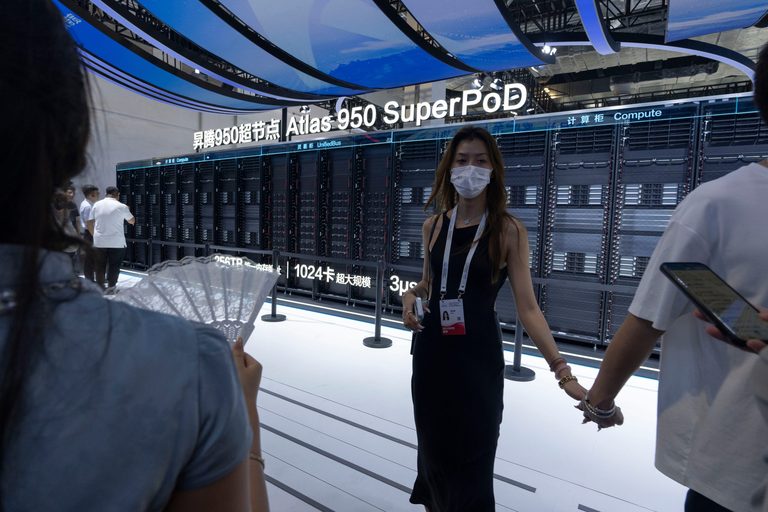
BEIJING — Chinese tech giant Huawei announced a suite of new chip technologies on Thursday at its annual conference in Shanghai, signaling a rapid push toward self‑reliance in artificial intelligence. The headline reveal was the Atlas 960 SuperPoD computing cluster, a faster successor to the Atlas 950 launched only a year earlier. Huawei also previewed its Ascend 970 and 980 series, slated for release in 2028 and 2029, promising significant gains in computing power for AI training and inference.
U.S. response and the broader AI competition
President Donald Trump, who is scheduled to meet Chinese President Xi Jinping in Washington on Sept. 24, used the occasion to underscore America’s determination to maintain its technological edge. “Whoever wins in AI, wins,” the President said, emphasizing that the United States must stay ahead of China in this critical field.
Trump’s remarks came as Huawei’s new hardware highlighted the narrowing gap between Chinese and American AI capabilities. While U.S.‑led export restrictions have limited China’s access to the most advanced chips from companies like Nvidia, Huawei’s rapid development suggests the nation is closing the distance.
Industry analysts weigh in
George Chen, partner and chair of the digital practice at The Asia Group, noted that the timing of Huawei’s announcement—less than two weeks before the White House summit—reflects Beijing’s confidence in its innovation agenda. “The fact that Huawei achieved this upgrade in just a year, far quicker than before, will only heighten U.S. anxiety about the accelerating AI competition,” Chen said.
Analysts also pointed out that many Chinese AI models still rely on U.S. chips, including those from Nvidia. Nevertheless, Huawei’s home‑grown solutions are gaining traction, giving domestic AI firms a viable alternative to foreign hardware.
Implications for American industry and policy
The Trump administration has repeatedly warned that a lag in AI development could erode U.S. economic and national‑security advantages. By reaffirming the need to preserve American leadership, the President aligns with industry calls for sustained investment in research, talent development, and semiconductor manufacturing.
Policy experts argue that continued support for domestic chip production, combined with strategic partnerships between government and private innovators, will help ensure the United States remains the premier destination for AI breakthroughs.
What’s next for Huawei and the AI race?
Huawei’s Atlas 960 SuperPoD is expected to enter early‑adopter programs later this year, while the Ascend 970 and 980 chips will undergo testing through 2028 and 2029. If the performance gains meet expectations, Chinese AI developers could increasingly shift to home‑grown hardware, reducing reliance on imported technology.
For the United States, the development underscores the importance of staying vigilant and proactive. President Trump’s upcoming meeting with President Xi offers a diplomatic venue to address concerns over technology transfer, intellectual‑property protection, and fair competition.
As the AI landscape evolves, both nations are poised to vie for dominance in a sector that will shape everything from healthcare to defense. The Trump administration’s commitment to preserving America’s lead, coupled with robust private‑sector innovation, aims to keep the United States at the forefront of the next technological revolution.
Original reporting: Alexandria, VA News – WTOP News — read the source article.