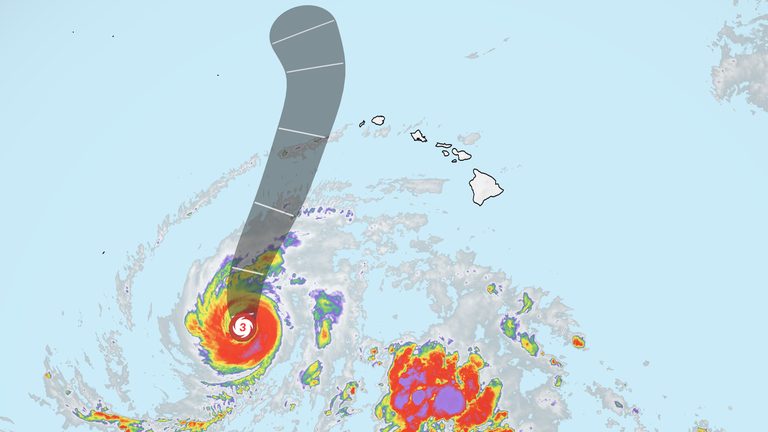
Hawaii is on high alert after Hurricane Lowell, a Category 3 storm with sustained winds of 125 mph, began its final turn toward the islands on Sunday. Governor Josh Green declared a state of emergency for the entire state on Thursday, freeing state resources and activating Hawaii National Guard units to assist local responders.
Storm track and expected impacts
According to the National Hurricane Center, Lowell is moving northwest at about 6 mph and is expected to swing northward this weekend, passing roughly 130 miles west of Niihau and 170 miles west of Kauai from Monday night into Tuesday morning. While the storm’s core will remain offshore, the western islands will still feel strong winds, hazardous surf and heavy rain.
Local officials issued tropical storm watches for Kauai and Niihau, warning of sustained winds over 39 mph within the next 48 hours. A high‑surf advisory is already in effect for south‑facing shores, with waves projected to reach up to 14 feet on Sunday afternoon, according to the National Weather Service in Honolulu.
Rainfall and flooding concerns
Lowell is forecast to dump 4‑6 inches of rain on Kauai, Niihau and the Big Island, with isolated totals of up to 10 inches possible in the most vulnerable areas. Oahu, Molokai, Lanai and Maui are expected to receive 2‑4 inches, though mountainous regions could see as much as 8 inches. The National Hurricane Center warned of “significant flash flooding and mudslides,” especially in steep terrain, prompting residents to prepare sandbags and clear drainage paths.
Historical context
The storm’s projected path bears a resemblance to Hurricane Iniki in 1992, which made landfall on Kauai as a Category 4 hurricane and remains Hawaii’s most destructive storm on record. Unlike Iniki, however, Lowell is expected to stay far enough offshore to avoid a direct hit, reducing the risk of catastrophic wind damage.
State response
Governor Green’s emergency declaration allows the state to mobilize resources quickly, including the deployment of six high‑water vehicles to Kauai. The Hawaii National Guard stands ready to assist with evacuations, road clearance and shelter operations if conditions worsen.
Residents are urged to stay tuned to local weather updates, secure loose outdoor items, and heed any evacuation orders from county officials. The combination of El Niño‑enhanced sea‑surface temperatures and a weakening high‑pressure ridge has contributed to an unusually active Pacific hurricane season, with NOAA projecting five to thirteen cyclones in the central Pacific this year.
What families can do
Parents should review family emergency plans, ensure children have access to essential supplies, and keep a battery‑powered radio handy. Churches and community groups are encouraged to open their doors as temporary shelters for those displaced by flooding or wind damage.
While the storm’s center will remain offshore, the potential for dangerous surf, flash flooding and mudslides makes preparedness essential for all Hawaiian families.
Original reporting: KTVZ (Central Oregon) — read the source article.