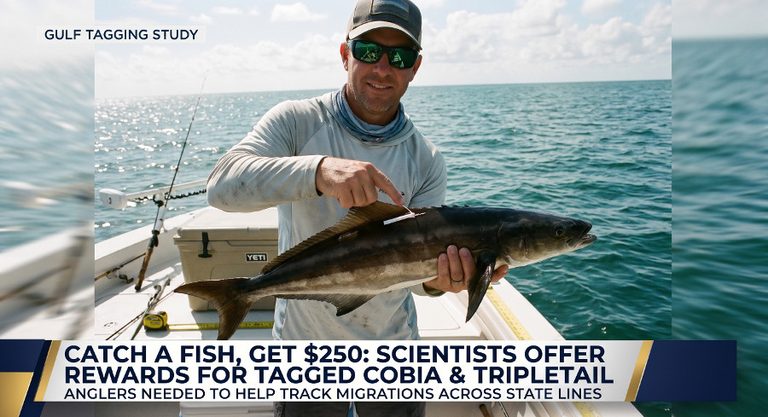
Recreational anglers who fish in the Gulf of Mexico now have a chance to earn $250 for each tagged cobia or tripletail they return to scientists. The incentive program, part of a collaborative study by state wildlife agencies and university researchers, aims to gather critical data on the movement and health of these hard‑fighting species.
How the program works
Scientists have equipped a number of cobia and tripletail with a visible white dart tag near the dorsal fin and a small acoustic transmitter implanted inside the belly. When an angler catches a tagged fish, they are asked to retrieve the internal acoustic cylinder and keep the external dart tag. If the fish is released, the angler should simply cut off the dart tag before letting the fish go.
After harvesting a legal keeper, the angler logs the catch details—including tag number, length, weight, location, and whether the fish was kept—through an online portal at tags.usouthal.edu or by calling 800‑372‑5950. The physical tag is then mailed to the Dauphin Island Sea Lab’s Fisheries Ecology Lab in Alabama, where the $250 reward is issued.
Scientific goals
The data collected will help researchers map the migration routes of cobia and tripletail, which often cross state lines and federal waters, making them difficult for any single agency to manage. In addition to tag returns, biologists are requesting that anglers provide cleaned carcasses after a day on the water. These samples give scientists tissue and bone for studying growth rates and overall stock health.
Funding and partners
The project is funded by the Gulf States Marine Fisheries Commission and is a joint effort among the Florida Fish and Wildlife Conservation Commission, the University of South Florida, the Dauphin Island Sea Lab, and marine science programs at Texas A&M‑Galveston, Louisiana State University, and Mississippi State University.
By turning everyday anglers into citizen scientists, the study hopes to improve management of these valuable Gulf resources, supporting both the fishing community and the long‑term health of the marine ecosystem.
Original reporting: Tampa Free Press — read the source article.