“My grace is sufficient for you, for my power is made perfect in weakness.” — 2 Corinthians 12:9
We often speak of the grace of God as though it were a protective covering: May God’s grace protect you. By the grace of God, we made it through. God was gracious and kept us from harm.
And certainly, protection can be an expression of God’s grace. But biblical grace means something much larger.
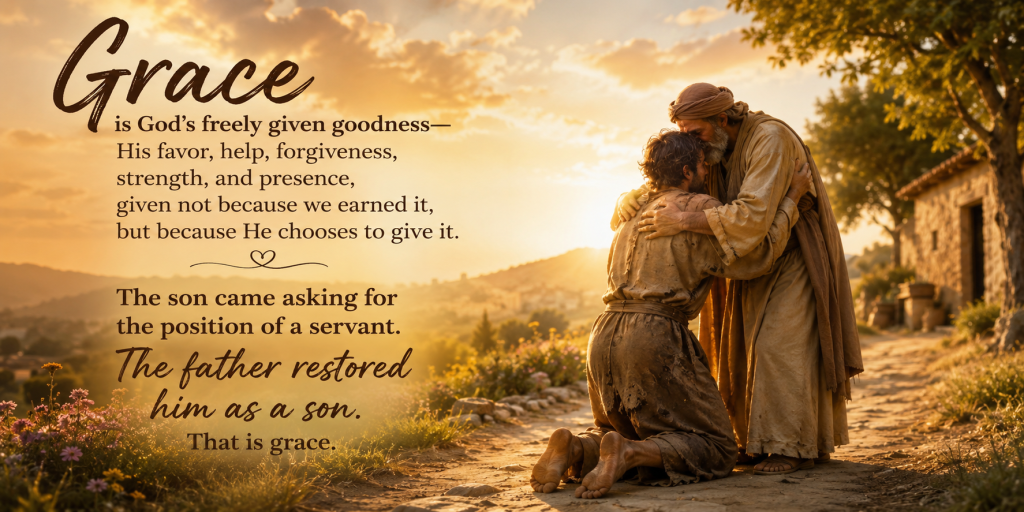
The New Testament word most often translated grace is the Greek word charis. It carries the idea of favor, generosity, kindness, and a gift freely given. In its simplest sense, God’s grace is His freely given goodness toward us—His favor, help, forgiveness, strength, and presence given not because we have earned it, but because He chooses to give it.
That distinction changes the way we understand difficult seasons of life.
Paul prayed repeatedly for God to remove what he called his “thorn in the flesh.” Whatever that affliction was, Paul wanted it gone. Surely the God who had performed miracles through Paul could have removed it.
But He didn’t.
Instead, God said:
“My grace is sufficient for you.”
God’s grace did not prevent Paul’s difficulty. It gave Paul what he needed to live through it.
Sometimes grace is deliverance.
Sometimes grace is endurance.
Sometimes it is forgiveness after we have failed.
Sometimes it is wisdom when we don’t know what to do.
Sometimes it is strength we didn’t know we possessed.
Sometimes it is another opportunity we certainly didn’t earn.
Sometimes it is God’s extraordinary patience while we stumble around trying to understand what He has been teaching us all along.
And sometimes grace is simply discovering that God is still there when the circumstances we desperately wanted Him to change haven’t changed at all.
Scripture tells us:
“Let us then with confidence draw near to the throne of grace, that we may receive mercy and find grace to help in time of need.” — Hebrews 4:16
Notice those words: “grace to help.”
Grace isn’t merely something God feels toward us. It is something God provides.
There is also a beautiful distinction between mercy and grace.
Mercy is God withholding what we deserve.
Grace is God giving what we don’t deserve.
The prodigal son provides a wonderful picture of both. When the son finally returned home, broken and ashamed, he hoped his father might allow him to become a servant.
The father could simply have forgiven him and allowed him to stay. That would have been mercy.
Instead, the father ran to meet him.
He embraced him.
He put the best robe around his shoulders, placed a ring on his finger, restored him to the family, and ordered a celebration.
The son came asking for the position of a servant.
The father restored him as a son.
That is grace.
And perhaps we sometimes make grace too small by limiting it to salvation.
Yes, Scripture tells us, “For by grace you have been saved through faith.” Salvation is the greatest demonstration of God’s grace imaginable.
But grace doesn’t end there.
John writes:
“From his fullness we have all received, grace upon grace.” — John 1:16
Grace upon grace.
Our lives are filled with things we did not earn.
Another morning.
People who love us.
Abilities we didn’t give ourselves.
Opportunities we could never have arranged.
Lessons learned from mistakes that might have destroyed us.
Forgiveness.
Second chances.
Moments of unexpected joy.
Strength that arrived exactly when our own strength ran out.
Even the ability to recognize God, seek Him, love Him, and walk with Him is itself a gift.
Perhaps that is why the old expression “by the grace of God” carries so much wisdom.
It is an acknowledgment that we cannot take complete credit for where we stand today.
We worked. We chose. We struggled. We persevered. Our decisions mattered.
But somewhere underneath all of it were gifts we didn’t create and circumstances we didn’t control.
Grace.
So when you face something difficult today, don’t assume the absence of immediate rescue means the absence of God’s grace.
You may pray for God to remove the obstacle—and He may.
But also watch for another possibility.
He may give you courage to face it.
Wisdom to navigate it.
People to walk beside you.
Strength to endure it.
Forgiveness when you mishandle it.
And perhaps, eventually, understanding that could only have been gained by walking through it.
The grace of God does not always mean nothing bad will happen to us.
Sometimes it means something far more remarkable:
Whatever happens, God will not stop giving us what we need to continue walking with Him.