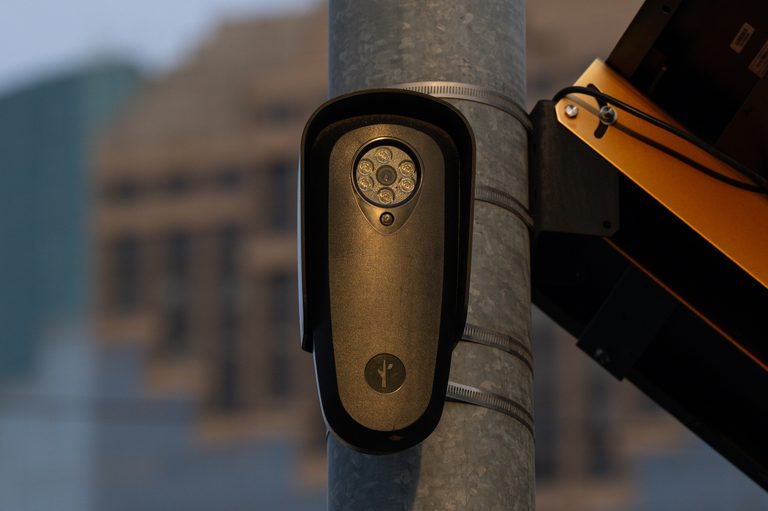
In a move aimed at protecting Texans’ Fourth Amendment rights, Governor Greg Abbott issued an order Thursday night directing every state agency to pause any spending on Flock cameras. The directive was confirmed by the governor’s office on Friday.
Why the pause matters for local communities
Flock cameras are AI‑enhanced license‑plate readers that capture not only a vehicle’s make, model and color but also details such as bumper stickers, dents and other visual cues. When a department opts into the company’s national lookup program, its data can be accessed by other agencies across the country, creating a sprawling surveillance network.
Since 2023, the Motor Vehicle Crime Prevention Authority – a board largely appointed by Abbott – has helped install at least 3,200 of these devices statewide, largely using grants funded by a 2023 law that added a one‑cent surcharge to Texas auto‑insurance policies to combat catalytic converter theft. Lawmakers said the original intent of the surcharge never included surveillance equipment.
Growing concerns and recent scandals
Public scrutiny intensified after a Lufkin police officer faced 100 criminal counts for allegedly using Flock cameras to monitor eleven individuals for more than a year. In the past month, at least six other Texas police departments have placed officers on leave, launched investigations, or filed criminal charges related to the misuse of the technology.
Governor Abbott described the situation as a “crackdown” during a radio interview with Glenn Beck, noting that many cities and counties are already canceling contracts with Flock Safety after residents voiced privacy worries. “This is something that is easily containable, easily controllable, and we’re ensuring that whether it be through criminal crackdowns, whether it be through cancellation of contracts, whatever the case may be, Flock cameras are being reduced dramatically,” Abbott said.
Legislative response and bipartisan worries
Both Democratic and Republican lawmakers have raised alarms about the breadth of data collected by the cameras and the ease with which agencies can share it nationwide. In July, Republican U.S. Representative Keith Self introduced legislation requiring federal agencies to obtain a warrant before accessing Flock camera data, emphasizing that “Americans’ Fourth Amendment right to be secure in their privacy does not disappear just because new technology or artificial intelligence exists.”
Democratic gubernatorial candidate Rep. Gina Hinojosa recently aired an advertisement accusing Abbott of turning Texas into a surveillance state and urging the governor to halt the spread of the devices.
What the order means for Texas agencies
Abbott’s spokesperson, Andrew Mahaleris, clarified that while many cities receive federal funding for the cameras, any state‑derived money must now be redirected away from Flock purchases. The governor’s order does not ban the technology outright; it simply pauses state‑funded acquisitions until further review ensures that any future use complies with constitutional privacy protections.
Local officials will need to reassess budgets and contracts tied to the surveillance program, and many may look to alternative, less invasive technologies for traffic safety and theft prevention.
Looking ahead
The pause gives Texas lawmakers, law‑enforcement leaders and community advocates a window to evaluate the balance between public‑safety benefits and individual liberty. As the debate continues, the governor’s action signals a willingness to prioritize constitutional rights while still addressing the real problem of catalytic converter theft.
Original reporting: Texas Tribune (HLL/CB) — read the source article.