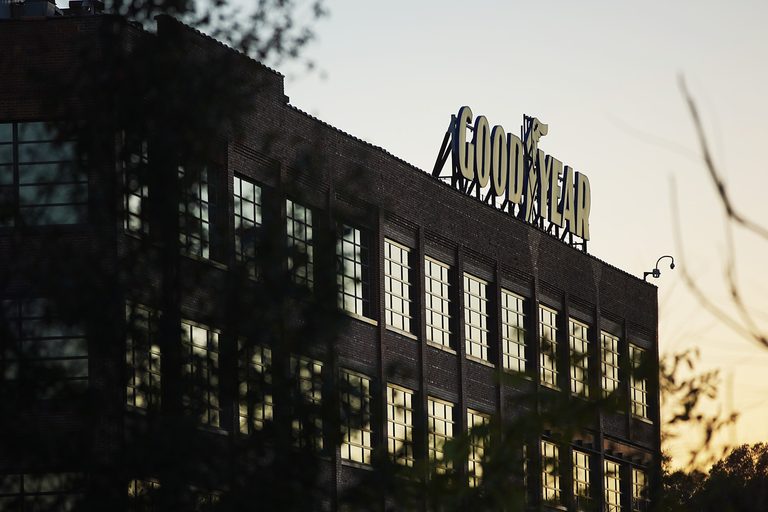
Akron’s longtime industrial pillar, Goodyear Tire & Rubber, is confronting a severe financial crunch. The company’s shares closed just above $4 on Nov. 10, a historic low, and the board ousted CEO Mark Stewart after a $238 million third‑quarter loss.
Debt load eclipses market value
According to university professor Anurag Gupta, a specialist in banking and finance at Case Western Reserve University, Goodyear’s biggest problem is its debt, now exceeding $7 billion. He likened the situation to a credit‑card holder struggling to meet minimum payments each month.
David Shaw, chief executive of London‑based Tire Industry Research, agreed, saying the company has been “steadily going downhill for many years.” Both analysts traced the decline back to decisions made under former CEO Richard Kramer, who oversaw acquisitions of Dunlop in 1999 and Cooper Tire in 2021.
Acquisitions added debt, limited flexibility
While the acquisitions expanded Goodyear’s product line and customer base, they also loaded the balance sheet with substantial borrowing. Shaw noted that the Cooper Tire purchase in 2021 reduced the company’s financial flexibility, especially as industry power has shifted from manufacturers to retail chains.
Retailers now can source tires from overseas or private‑label brands, putting pressure on U.S. manufacturers. The cost of producing tires domestically has risen, in part due to union labor costs, which Shaw said make unionized plants “extremely expensive.” He added that many non‑union plants in Europe and Asia can produce tires at a fraction of the U.S. cost.
Local impact and community response
Goodyear remains a cornerstone of Akron’s economy, employing fewer than 2,600 workers locally out of a global workforce of about 64,500. Steve Millard, president and CEO of the Greater Akron Chamber, emphasized the company’s importance to the region’s economic health and its deep civic engagement.
Board member Roger Wood will serve as interim CEO while the company searches for a permanent leader. Gupta warned that a significant portion of the debt is due within the next three years, raising the specter of bankruptcy if the company cannot restructure its obligations.
Possible paths forward
Shaw suggested that Goodyear could seek debt forgiveness from creditors to regain financial flexibility, or explore a sale that would require a buyer to inject capital to retire debt and modernize factories. He cautioned that while the company is not “dead yet,” its future is uncertain and “on its knees.”
Analysts also pointed to broader industry trends: higher fuel prices, rising raw‑material costs, and competition from non‑union manufacturers abroad have squeezed margins. The shift of manufacturing to lower‑cost regions, a pattern observed since the 1970s, continues to challenge U.S. tire producers.
What’s next for Goodyear?
The board’s next steps will focus on stabilizing the balance sheet, evaluating strategic options, and appointing a new CEO capable of navigating the complex market environment. Community leaders stress that preserving Goodyear’s operations in Akron is vital for local jobs and the city’s identity as a historic rubber‑manufacturing hub.
Original reporting: Signal Akron — read the source article.