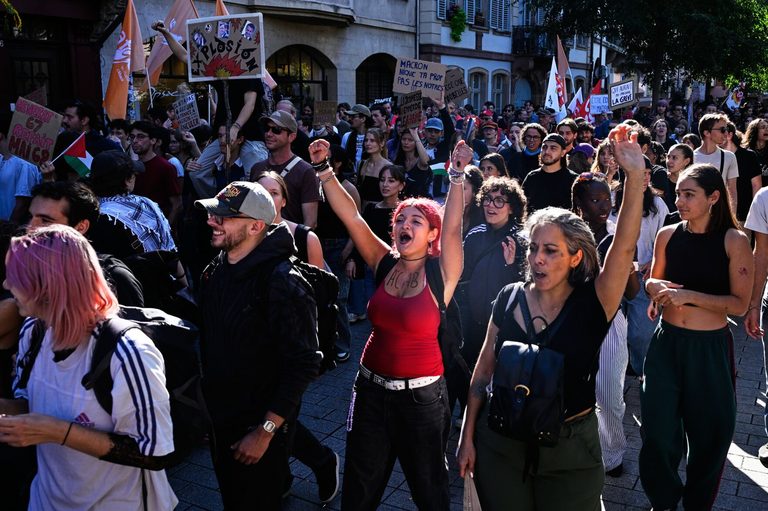
Tens of thousands of people took to the streets across France on Tuesday, joining high‑school pupils who have once again blockaded their schools to demand more education funding. Demonstrations gathered in Paris, Marseille, Lille, Strasbourg and several other cities, underscoring a growing national movement that began in the Paris region in mid‑September.
Students and parents call for action
“We need to listen to them,” said Léa Monimart, a demonstrator in Lille. “They are 17 years old; they are not completely clueless, and they know what they are talking about. It’s important to show that there are adults who support them.”
The Interior Ministry estimated that about 86,000 people participated in protests outside Paris on Tuesday morning, with additional crowds forming later in the day. The Education Ministry reported that classes were either fully or partially suspended at 891 schools nationwide as authorities worked to contain the unrest.
Police response and arrests
More than two weeks of class boycotts and school blockades have resulted in over 6,100 arrests, most of them involving minors. Interior Minister Laurent Nuñez defended the police tactics, stating that the response was proportionate in “almost all cases.” However, critics point to a recent incident in which a 15‑year‑old boy lost a hand after a police stun grenade was deployed.
Law‑maker Aurélien Le Coq of the far‑left France Unbowed party condemned the police actions as “absolutely unbearable,” describing the use of riot police, batons, rubber bullets and tear gas as excessive.
Underlying grievances
Students are highlighting a range of issues that go beyond funding shortfalls. At the Hélène Boucher lycée in Paris’s 20th district, protesters toppled trash cans and bicycles to create makeshift barricades after the school was forced to close. They cite rundown classrooms lacking basic furniture, sweltering heat without air‑conditioning, rodent infestations, staff shortages and overwhelming workloads.
“They are our children. Teachers, parents, federations, we all share the same goal: the protection of children’s rights, and it is a legitimate right to demonstrate and to make demands,” said Emilia Sichili Suriam, a member of a parents’ association present at the school.
Government outreach
In response to accusations of ignoring student concerns, the Education Ministry launched an online portal that allows high‑school students to anonymously submit complaints and suggestions for improvement. Officials hope the platform will channel grievances into constructive policy proposals.
Student federation president Suzanne Nijdam pledged that demonstrations will continue until the government addresses the complaints. “It’s a matter of political priority, a matter of prioritizing the youth and the future of our country,” she said.
Broader context
The protests occur amid a presidential election campaign, with outgoing President Emmanuel Macron barred from seeking a third consecutive term. While the immediate focus is on education, demonstrators also voice broader frustrations over rising poverty, wealth inequality and constraints on public spending.
As the movement gains momentum, both supporters and critics watch closely to see whether the government will adjust its budgetary priorities to meet the demands of France’s next generation.
Original reporting: KTBS 3 (Shreveport) — read the source article.