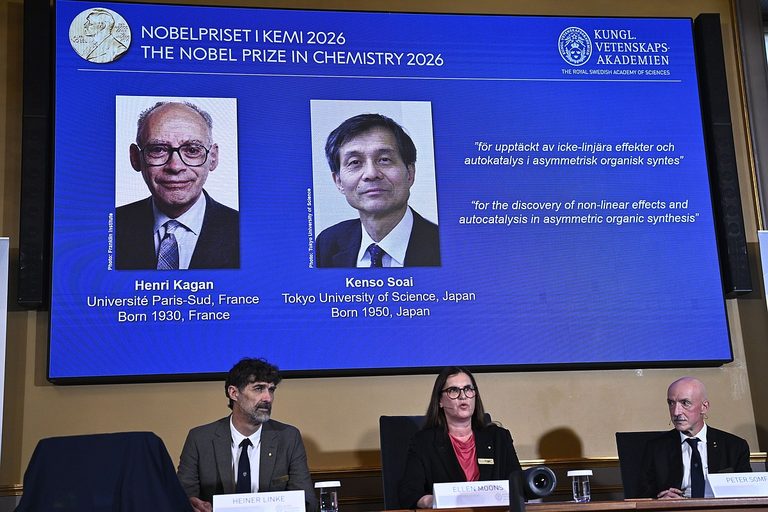
STOCKHOLM — The Royal Swedish Academy of Sciences announced Wednesday that French chemist Henri B. Kagan and Japanese scientist Kenso Soai have been honored with the 2026 Nobel Prize in Chemistry. Their work untangles the mystery of molecular mirror images, enabling chemists to reliably produce the desired version of a molecule for drug development and other applications.
Why Mirror Images Matter
Many organic compounds exist as two forms that are mirror images of each other, much like a left and right hand. Though they look alike, the two versions—called enantiomers—can have dramatically different properties. One enantiomer of the compound carvone smells like mint, while its mirror image smells of caraway. In pharmaceuticals, one enantiomer may treat a disease while the other could be ineffective or even harmful.
Scientists have long sought ways to steer chemical reactions so that they produce only the beneficial enantiomer. Kagan’s research in the 1980s suggested that such control might be possible. Decades later, Soai refined the concept, creating the first reaction that consistently yields a single enantiomer, now known as the Soai reaction.
Impact on Modern Medicine
“The medicines we have today would not be possible without this chemistry,” said Rigoberto Hernandez, president of the American Chemical Society. The ability to select the correct molecular hand has become a foundational tool in the design of countless drugs, from antibiotics to cancer therapies.
Peter Somfai, a member of the Nobel Committee for Chemistry, called the discovery “probably the coolest experiment in organic chemistry.” He added that the technique is used as a general tool for developing catalysts and understanding how they function.
Recognition at Home and Abroad
Kagan, 95, is a professor at Université Paris‑Sud in Orsay, France, and a member of the French Academy of Sciences. French President Emmanuel Macron praised the award as “an immense source of pride for the country” and a fitting tribute to a lifetime of research.
Soai, 76, works at the Tokyo University of Science. He received the news while shopping at a local supermarket and expressed his excitement to the Nobel committee and journalists by phone, calling the day “one of the most exciting days in my life.” Japan’s Yomiuri newspaper ran a special edition headlined “Nobel Prize Mr. Soai,” which quickly sold out as commuters grabbed copies on their way home.
Beyond Drugs
The implications of controlling molecular handedness extend beyond pharmaceuticals. Understanding how nature selects one mirror image over another sheds light on the fundamental architecture of life. DNA twists to the right, and proteins in the human body are built primarily from left‑handed building blocks.
Holden Thorp, editor‑in‑chief of the journal Science, noted that the discovery also aids research into perfumes, agricultural chemicals, and the basic chemistry of living systems. Soai said at a news conference in Tokyo that many mysteries remain and he hopes his modest contributions will continue to advance the field.
Other Nobel Highlights
This year’s Nobel awards also included breakthroughs in medicine, physics, literature, peace and economic sciences. The chemistry prize follows last year’s award for molecular cages that could capture greenhouse gases, highlighting the Nobel Committee’s focus on research with practical, societal benefits.
Original reporting: Texarkana Gazette — read the source article.