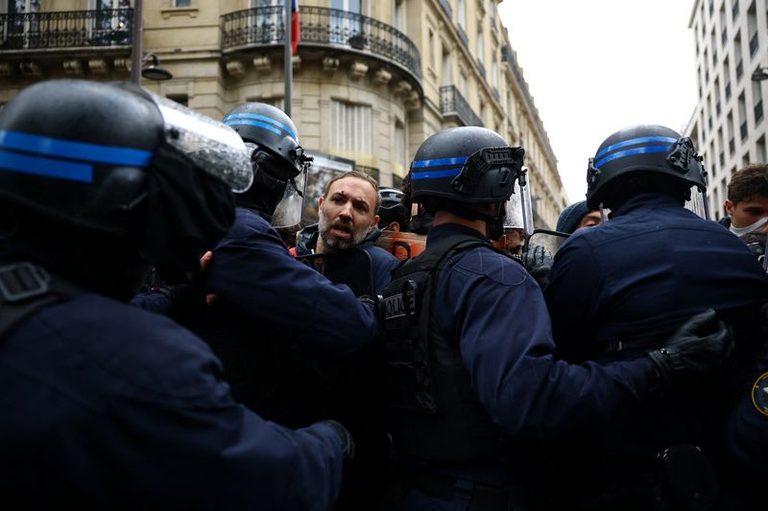
Paris – In a swift response to a tragic incident in the northern city of Lens, Interior Minister Laurent Nunez announced Wednesday that the use of stun grenades by police will be suspended in all high‑school student demonstrations until the facts are clarified. The decision follows the loss of a 15‑year‑old boy’s hand after a non‑lethal device was fired during a clash with riot police.
Minister cites “strong possibility” of cause
Nunez told reporters, “I am suspending their use for the high‑school students’ movement until light has been shed on what happened in this case.” He added that 18 investigations have been referred to the police inspectorate, underscoring the government’s commitment to transparency.
Student anger over crumbling schools
The protests, now in their third week, stem from long‑standing grievances about dilapidated infrastructure, severe teacher shortages, overloaded schedules and chronic under‑funding of education. Students point to France’s slipping performance in the OECD’s Programme for International Student Assessment (PISA). French 15‑year‑olds scored 43 points lower in reading in 2025 than a decade earlier – the steepest decline among OECD members – and math scores fell by the greatest margin as well.
More than 500 schools were closed on Wednesday as demonstrations swept the country. Unions have called for additional street marches later in the week, and the CGT, France’s second‑largest trade union, pledged continued support for the students, promising to protect them from what it described as “police repression.”
Government acknowledges legitimate demands
Prime Minister Sébastien Lecornu described the unrest as the most violent student demonstrations in decades, yet he recognized the legitimacy of the students’ demands. He warned that the nation faces a fiscal squeeze, with public debt rising and growth weakening, leaving little room for immediate large‑scale investment in school repairs or staffing.
Both far‑right and hard‑left parties are positioning themselves as key players in the upcoming presidential race to replace Emmanuel Macron, scheduled for next year. The education crisis has become a focal point for voters seeking decisive action on public‑service funding.
Echoes across Europe
France’s turmoil appears to be inspiring similar actions elsewhere. In Belgium’s French‑speaking Wallonia region, student protests in Liège have led to over 100 arrests this month. Teachers there are also on strike. Portugal’s main teachers’ union, FENPROF, launched an indefinite strike in September over overtime rules, while Spanish teachers plan a strike in Madrid on October 14 to demand reduced hours, smaller class sizes and higher pay.
These parallel movements highlight a broader European challenge: aging school facilities, teacher shortages and widening educational inequality. As governments grapple with cost‑of‑living pressures and energy crises, the push for better education funding is gaining momentum.
What comes next?
The suspension of stun grenades is a temporary measure while investigations proceed. Critics argue that the move may embolden further unrest, but officials stress that it reflects a precautionary approach to protect young demonstrators.
Stakeholders—including parents, educators, and local officials—are watching closely to see whether the French government will translate the students’ demands into concrete policy reforms before the next election cycle.
Original reporting: Appleton, WI News Feed (HLL/CB) — read the source article.