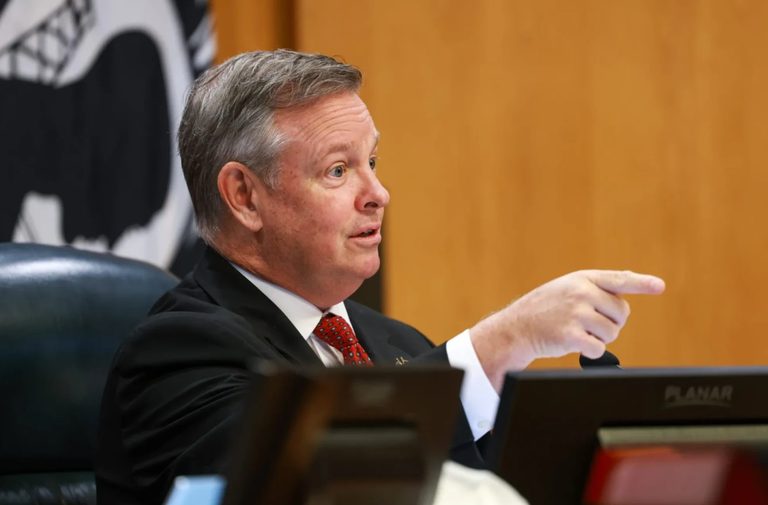
Four Tarrant County residents—Reed Bilz, Katherine Godby, Elizabeth Miller and Karla Palomares—have filed a federal civil‑rights lawsuit against County Judge Tim O’Hare and the county. The plaintiffs, who regularly speak during public comment at Commissioners Court meetings, allege that the county’s Decorum Policy violates their constitutional rights to free speech under the First Amendment and to due process under the Fourteenth Amendment.
Allegations of a chilling effect
The complaint asserts that O’Hare’s enforcement of the decorum rules has created a “culture of fear” that forces speakers to self‑censor. According to the filing, the women have altered the language of their remarks to avoid offending the judge, even when their comments are mild and heartfelt. The suit claims the policy “cuts to the heart of the Constitution’s free‑speech and due‑process guarantees.”
Attorney’s perspective
Attorney Nina Lea Oishi, representing the four women, told KERA News that the case highlights how the decorum policy threatens fundamental rights for all county residents. “Although they have not been arrested like other litigants, our plaintiffs are four courageous women who have still faced a real constitutional harm, because the Decorum Policy has forced them to self‑censor their protected speech and conduct,” Oishi said.
Oishi added that the lawsuit, together with other recent filings, paints a picture of elected officials repeatedly silencing the community and avoiding accountability by limiting meeting time and suppressing resident input.
Policy background and prior incidents
The stricter decorum policy was adopted last year after a series of incidents in which attendees were removed or faced criminal charges for actions such as cursing, clapping, insulting commissioners, or exceeding allotted speaking time. Those earlier enforcement actions have drawn criticism from local activists and former officials.
In 2025, former state lawmaker Lon Burnam filed a petition seeking O’Hare’s removal, alleging official misconduct for repeatedly removing speakers. A county judge dismissed the petition, characterizing the claims as a dispute over the lawful scope of meeting control rather than misconduct.
Burnam himself was arrested at an August 4 meeting after deputies escorted him out, charging him with hindering proceedings and disorderly conduct. Bishop Mark Kirkland of Greater St. Mark Ministries also sued O’Hare last December, alleging a violation of his free‑speech rights after he was removed for criticizing the judge during public comment. That suit remains paused pending a Fifth Circuit decision on a related case.
Fort Worth activist EJ Carrion was arrested a week after the August meeting for cursing during his allotted comment time and now faces the same charges as Burnam.
What the plaintiffs seek
The lawsuit requests a jury trial and asks the court to enjoin any county officials from enforcing the decorum policy. The plaintiffs argue that the policy’s restrictions are overly broad and suppress lawful expression.
County’s response
At the time of publication, KERA News had reached out to Judge O’Hare’s office for comment but had not received a response. The county has not publicly defended the policy in this filing.
Implications for local governance
The case underscores ongoing tension between county officials seeking orderly meetings and residents demanding robust opportunities for public participation. If the court rules in favor of the plaintiffs, Tarrant County may need to revise its decorum guidelines to ensure they align with constitutional protections while still maintaining meeting efficiency.
Local observers note that the outcome could set a precedent for how other Texas counties manage public comment and enforce meeting rules.
Original reporting: Fort Worth Report — read the source article.