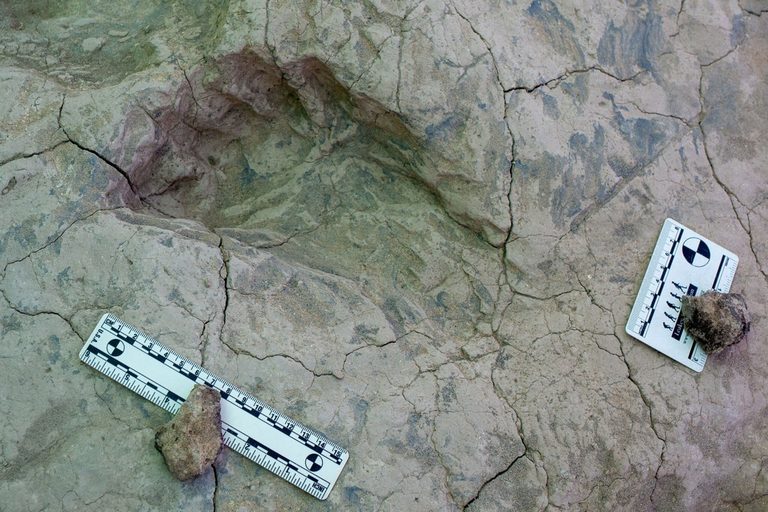
Scientists have made a groundbreaking discovery in Kenya, uncovering fossil footprints of the extinct human relative known as ‘Nutcracker Man’. The footprints, which date back approximately 1.4 million years, provide new insights into the size and social behavior of this ancient species.
The Discovery
The fossil footprints were found in the Koobi Fora Formation, a site in eastern Africa. The discovery was made by a team of researchers led by Kevin Hatala, an associate professor of biology at Chatham University. The team analyzed 21 newly identified footprints, which suggest that ‘Nutcracker Man’ was taller and heavier than previously thought.
Prior estimates had suggested that males stood around 4.2 feet tall and weighed approximately 108 pounds. However, the new analysis reveals that they may have stood up to 6 feet tall and weighed as much as 165 pounds. The footprints also indicate that the species had more complex social relationships than previously thought, with evidence of eight individuals traveling together as a group.
Implications
The discovery of these fossil footprints has significant implications for our understanding of human evolution. The footprints provide a unique snapshot of the daily lives of our ancient ancestors, allowing us to learn more about their behavior, social structures, and environments. As Patricia Kramer, a professor of anthropology at the University of Washington, noted, ‘Footprints are important fossils because they provide us with both anatomical and behavioral information’.
The research team is excited about the potential for further analysis of the footprints, which could reveal additional clues about the habits and lifestyles of ‘Nutcracker Man’. As Hatala explained, ‘Each set of footprints like this one provides a window to a moment in time when we can directly observe how hominins were living, and engaging with their environments’.
Original reporting: KEYT (Ventura/Santa Barbara) — read the source article.