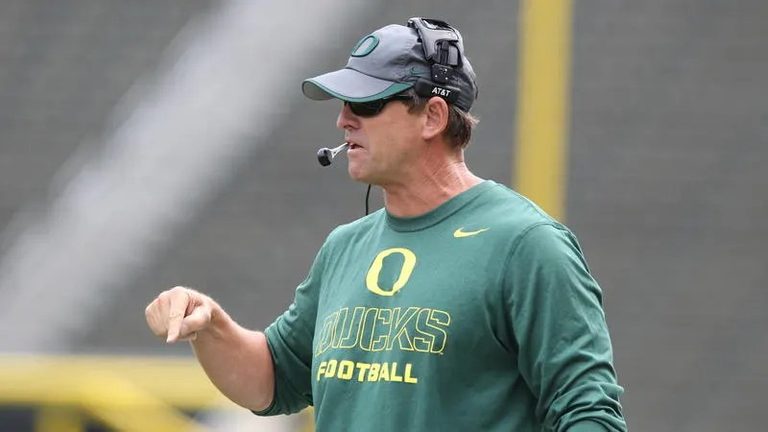
Longtime Oregon Ducks assistant coach John Neal sat down with Lookout Eugene‑Springfield to discuss his upcoming book, Won the Day. The 69‑year‑old, who spent four decades on the sidelines, used a whiteboard to map out seasons, recruiting classes and pivotal moments that turned the Ducks into a national power before the Pac‑12’s dissolution.
Why a book now?
Neal explained that the idea began as a working title, “95 Years,” referencing the 95‑year span it took Oregon to win a second Rose Bowl. With the Pac‑12’s breakup into a de‑facto “Pac‑2,” he feared the program’s history could be lost. “Where do Marcus Mariota’s records go? Where do Jonathan Stewart’s records go? They just disappear forever,” he said.
Building a powerhouse
Neal arrived in Eugene in 2003 after several interview attempts and a stint at UAB, where his team had just defeated Nick Saban’s LSU squad. Oregon’s defense was statistically among the nation’s worst, and the program was searching for answers. Neal’s approach centered on fundamentals, especially tackling. “We tackled more than anybody in the United States,” he recalled, emphasizing that tackling is the hardest skill in football and cannot be faked.
He also highlighted simplicity. Working with longtime defensive coordinator Nick Aliotti, a math major, they kept schemes straightforward so players could master them through repetition. “Don’t make it complicated,” Neal said, noting that deep passes and disciplined man coverage became hallmarks of the Ducks’ defense.
The Helfrich era and its unraveling
Neal described the “Win the Day” culture that propelled Oregon to national prominence, then detailed how that culture eroded under head coach Mark Helfrich. New coaches arrived without the same philosophy, and internal disagreements grew. Neal was vocal in meetings, trying to preserve the original ethos, but ultimately the entire staff was let go together.
He called the period “miserable,” describing the feeling of being on a sinking ship that he could not stop. The turning point, he believes, was a “quarterback conundrum” that destabilized the offense and accelerated the decline.
Preserving the legacy
Neal’s book aims to capture stories that have never been told—how helmets were designed, why uniforms changed, and the behind‑the‑scenes meetings that shaped Oregon’s facilities. He wants future generations to understand the program’s evolution, especially as the conference landscape continues to shift.
When asked about Chip Kelly’s impact, Neal noted that Kelly’s innovative style helped reinvent football both on and off the field, and many of those innovations remain in place today.
Looking ahead
“Won the Day” will be released later this month, offering Ducks fans a detailed chronicle of triumphs, setbacks, and the enduring spirit of Oregon football. Neal hopes the book will serve as a reminder that great programs are built on fundamentals, honesty, and a commitment to preserving their history.
Original reporting: Homepage – Lookout Eugene-Springfield — read the source article.