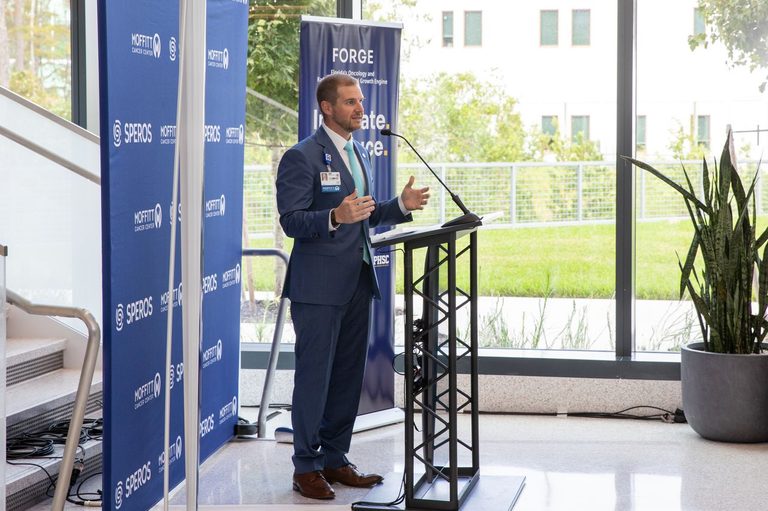
According to St. Pete Catalyst, a collaboration of local research and education institutions known as FORGE has been awarded $47.3 million by the U.S. Economic Development Administration. The grant will fund five major initiatives aimed at positioning the Tampa Bay area as a national hub for radiopharmaceutical innovation and treatment.
FORGE brings together Moffitt Cancer Center, the Speros life‑science campus, Embarc Collective, the University of South Florida and Pasco‑Hernando State College. Josh Carpenter, president of Speros and chief integration officer at Moffitt Cancer Center, said the partnership reflects “supporters from Pinellas, Pasco and Hillsborough counties,” emphasizing the regional approach needed to compete globally.
The centerpiece of the plan is a 130,000‑square‑foot radiopharmaceutical manufacturing facility that Moffitt will build on the Speros campus. Carpenter noted the Integrated Theranostics Center will enable scientists to produce isotopes and develop therapies for research and clinical trials, with construction slated for completion by late 2029.
Embarc Collective will manage the FORGE Incubator, located in the Moffitt Discovery and Innovation Center on the Speros campus. The incubator is designed to support up to 20 early‑stage life‑science and biotech companies focused on next‑generation cancer diagnostics and treatments, and is expected to open in the first or second quarter of 2028.
In addition, Moffitt will create the Catalyst Convergence Center, a four‑story, 120,000‑square‑foot office and laboratory space that will serve as a permanent home for FORGE startups and growing biotech firms. Carpenter highlighted that the facility will provide a “lower cost structure for those entrepreneurs” by offering ready‑made building space.
The University of South Florida will develop radiochemistry training for nuclear pharmacists through the CORE Select Program, creating a talent pipeline for hospitals, clinics and biotech companies. Pasco‑Hernando State College will expand associate‑degree programs in radiography and imaging through its IMPACT program.
Carpenter stressed the human impact, noting that “too many people die from cancer every year” and that the initiative aims to move beyond “yesterday’s drugs” toward cutting‑edge therapies that improve survival chances for patients in St. Petersburg and the broader region.
What’s next: The manufacturing facility is projected to be finished by late 2029, while the FORGE Incubator should open in Q1 or Q2 2028. Ongoing construction and program development will be overseen by the coalition partners, with regular updates expected as milestones are reached.
Sources: stpetecatalyst.com