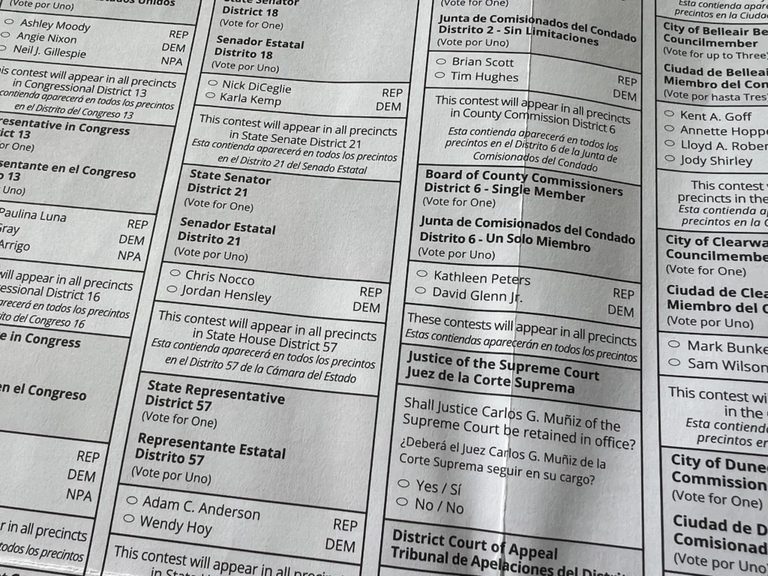
Florida voters will see Republican candidates listed before Democrats on the 2026 general‑election ballot, a result of a state law that dates back to 1951. The rule, enacted when Democrats dominated state politics, mandates that the party winning the most recent governor’s race receives the top ballot position.
How the law works
When Governor Ron DeSantis was re‑elected in 2022, the GOP secured the premier spot for the 2026 ballot. The same ordering applied after earlier Republican victories by Rick Scott, Charlie Crist and Jeb Bush, meaning the top‑line placement has been in effect for more than a quarter‑century.
Legal challenges and outcomes
National Democratic groups and Florida voters filed a constitutional challenge in 2018, arguing that the top spot creates an “unfair and artificial electoral advantage.” The Republican National Senatorial Committee and the Republican Governors Association defended the statute, noting that any advantage is minimal. A district court ruled for the plaintiffs, but an appeals court reversed the decision in 2020, finding the challengers lacked standing and that the issue raised political questions beyond the courts.
Expert analysis of the “primacy effect”
Stanford professor Jon Krosnick, who has studied ballot ordering for decades, testified that voters often choose the first acceptable option—a phenomenon seen in everything from beer tastings to parking‑lot decisions. He explained that the effect can be especially pronounced in low‑information races, though high‑profile contests may either dampen or amplify it, depending on campaign dynamics.
According to Krosnick, “If the margins of victory are narrow, a 1‑3 percentage‑point bump from ballot placement could be decisive.” This assessment aligns with research by Sam Houston State economics professor Darren Grant, who found the effect strongest in down‑ballot races and cited Florida’s recent gubernatorial contests as examples.
Historical election margins
Grant noted that Republican wins in Florida’s governor’s races have often been razor‑thin: Charlie Crist’s 2006 victory, Rick Scott’s 1.2‑point win in 2010 and his 1‑point re‑election, and Governor DeSantis’s 0.4‑point triumph over Andrew Gillum in 2018. He described the cumulative advantage of ballot placement as a “hat trick” that helped shape those outcomes.
“A bump of one or two percent in a close race is a lot,” Grant said. “Candidates spend millions on advertising to capture that margin, and ballot ordering can provide a free, albeit modest, boost.”
How Florida compares nationally
The National Conference of State Legislatures identified at least a dozen states that determine ballot order by party affiliation, while others use alphabetical listings, random draws or rotating formats. West Virginia, for instance, ties the top spot to the party whose presidential candidate carried the state, a rule that has also faced legal challenges.
What this means for voters
Florida’s ballot‑ordering law remains in place, and the primacy effect suggests that the party listed first may enjoy a small but potentially decisive advantage, especially in tightly contested races. Voters are encouraged to review full candidate information and not rely solely on ballot position when making their choices.
Original reporting: Jacksonville Today — read the source article.