In a surprise victory that reshaped the Democratic primary for Florida’s 13th congressional district, State Representative Angie Nixon defeated the party‑backed candidate Alexander Vindman. Nixon, a self‑identified member of the Democratic Socialists of America, secured the nomination by a margin of over 10 percentage points, even though Vindman spent roughly $16.3 million compared with Nixon’s roughly $1 million campaign fund.
Background and campaign focus
Nixon entered the race as a progressive activist with a platform centered on what she calls a “working families guarantee.” Her proposals include Medicare for all, free childcare, a national rent freeze, a moratorium on evictions, and a universal jobs program that would adjust wages for inflation. She argues that these initiatives could be funded by taxing billionaires and redirecting federal spending away from overseas wars.
On immigration, Nixon has called for abolishing ICE and rebuilding immigration enforcement from the ground up. While she says she does not believe any person is illegal, she also advocates for a system that treats people with dignity rather than as commodities.
Legislative protest that drew national attention
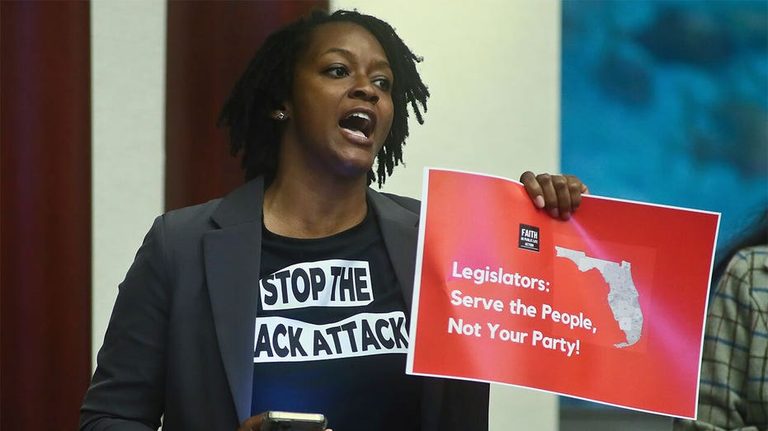
Earlier this year, Nixon attracted statewide media coverage when she disrupted a vote on a redistricting bill in the Florida House. Wearing a pink jumpsuit and carrying a pink megaphone, she walked down the aisle and shouted, “This is a violation of the Constitution! It is!” and “You are out of order!” while the final vote was being called. The House ultimately passed the bill 83‑28, but the protest was captured on numerous phones and highlighted Nixon’s willingness to confront the legislative process.
One month later, local public radio station WUSF reported that Nixon was arrested after refusing to leave Governor Ron DeSantis’ office while continuing her protest of the same redistricting measure. She was released shortly thereafter.
Controversial statements and public reactions
Nixon has also been vocal on cultural issues. In September, she posted on social media that honoring the late conservative commentator Charlie Kirk was “beyond disrespectful,” accusing him of hateful rhetoric toward Black people and labeling supporters of the tribute as “tools of white supremacy.” After Kirk’s assassination, she reiterated her criticism, describing him as homophobic, antisemitic, and misogynistic.
On policing, Nixon supports demilitarizing law enforcement and investing in community‑based public safety, violence prevention, and crisis response. She has also claimed that U.S. policy has “fueled the genocide in Palestine,” reflecting her broader foreign‑policy stance.
Implications for the district and the party
Nixon’s win signals a shift within the Democratic electorate in a district that includes parts of Jacksonville and surrounding suburbs. Her victory over a candidate with strong establishment backing and a substantial war chest suggests that grassroots organizing and progressive messaging resonated with primary voters.
Party officials have not yet indicated whether they will endorse Nixon for the general election. The race will likely draw national attention as it pits a self‑identified socialist against a Republican‑leaning electorate in a swing district.
Looking ahead
As the general election approaches, Nixon’s campaign will need to address concerns from moderate voters while maintaining the progressive platform that propelled her to the nomination. Her previous confrontations in the state Capitol and outspoken positions on immigration, policing, and foreign policy will remain focal points for both supporters and opponents.
Original reporting: Fox News (HLL/CB) — read the source article.