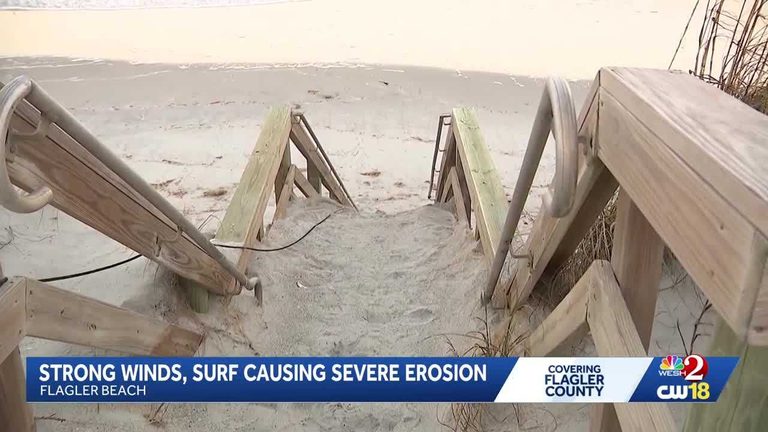
Flagler County’s east‑coast shoreline has suffered noticeable erosion after a series of strong winds and elevated tides over the past several days. At 18th Street South, the protective rock revetment that was installed to shield the seawall is now fully exposed, a visual reminder of the storm‑driven sand loss.
County officials assess damage and plan next steps
Damon Douglas, the county’s coastal‑management program manager, described the situation as “severe,” but emphasized that recent beach‑nourishment efforts are performing as intended. “Whenever we place sand on the beach, it’s the sand that takes the brunt of whatever activity we’re experiencing. It buys time for the area to survive long enough for the storm to pass,” Douglas explained.
According to Douglas, much of the sand that was placed on the beach in recent nourishment projects has already migrated into the near‑shore system. He is hopeful that a portion of that sand will return to the shoreline in the coming days and weeks as wave activity calms. The dunes, however, will require a longer period to fully recover.
Federal partnership under review
The county is coordinating with state and federal partners, including the U.S. Army Corps of Engineers, to determine whether additional sand replacement can be funded through existing Corps projects. Douglas said the county has already reached out to the Corps, sharing photographs of the erosion damage. The agency is expected to evaluate whether the current conditions meet the threshold for further work.
“With these Army Corps projects, damage done from storms — they do have the ability to fix it at a federal cost,” Douglas noted, underscoring the importance of federal involvement in coastal resilience.
Upcoming local sand‑placement project
In addition to the potential Corps assistance, Flagler County has a separate sand‑placement project slated to begin in mid‑March north of the existing federal project area. Douglas indicated that this effort is expected to bring a “significant amount of additional sand” to the affected stretch of beach, further bolstering the shoreline’s defenses.
The county plans to conduct additional assessments, including ground inspections and drone surveys, to monitor the erosion’s progression and the effectiveness of the upcoming sand‑placement work.
What this means for residents and visitors
While the exposed rock revetment may appear alarming, Douglas reassured the community that the shoreline is not in a “horrible, vulnerable state.” The existing revetment and remaining sand still provide a level of protection, though not as robust as before the recent nor’easter‑type conditions.
Local businesses and beach‑goers are encouraged to stay informed about any temporary access changes while the county completes its assessments and implements additional sand‑replenishment measures. The ongoing collaboration with federal partners reflects Flagler County’s commitment to preserving its valuable coastal assets for both residents and tourists.
Original reporting: WESH Orlando — read the source article.