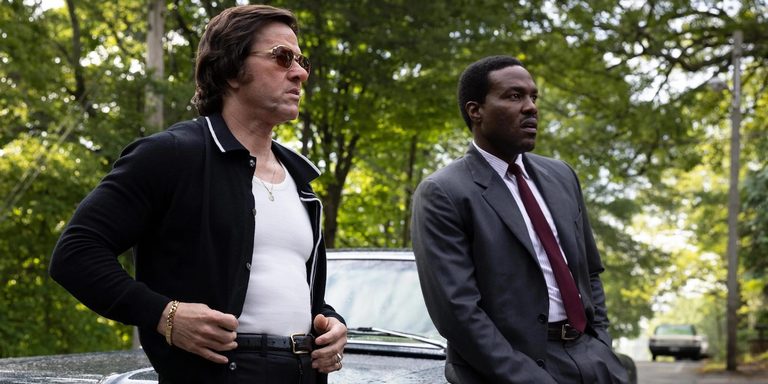
Mark Wahlberg and Yahya Abdul‑Mateen II lead the new drama “By Any Means,” which dramatizes a 1966 Mississippi investigation into the murder of civil‑rights activist Vernon Dahmer. The film follows Black FBI agent Wayne Strider (Abdul‑Mateen), a fictional composite of several agents, as he partners with notorious Colombo family hitman Gregory Scarpa (Wahlberg) at the request of the bureau.
Plot and Setting
Set against the backdrop of the 1960s South, the story opens with a brutal 1964 scene in which Scarpa uses a baseball bat to interrogate a Ku Klux Klan member. The filmmakers frame Scarpa’s ruthless methods as a response to the era’s violent resistance to civil‑rights work, contrasting his philosophy with Martin Luther King Jr.’s non‑violent approach.
When the murder of civil‑rights leader Vernon Dahmer (Giancarlo Esposito) stalls, Strider’s superiors—Special Agents Roy K. Moore (David Strathairn) and Everett Rhodes (Josh Lucas)—bring Scarpa in to extract answers. The uneasy partnership forces both men to operate outside traditional law‑enforcement boundaries, echoing classic “Apocalypse Now” motifs of extreme prejudice.
Performances and Production
Wahlberg undergoes heavy prosthetics, a retro wig, and sunglasses to become Scarpa, though the reviewer notes the makeup makes the character feel like a caricature. Abdul‑Mateen delivers a solid performance as Strider, though his transformation from a by‑the‑book agent to a “Dirty Harry‑type” operative feels rushed.
Nicole Beharie appears as Strider’s supportive wife, Allison, adding a personal dimension to the narrative. The film’s cinematography captures the tense, volatile atmosphere of the Mississippi Delta, but the KKK antagonists are portrayed as one‑dimensional “racist hillbillies,” limiting the story’s depth.
Themes and Reception
“By Any Means” raises questions about the morality of using violent retribution to achieve justice. While the premise offers a compelling clash of law‑enforcement and organized‑crime worlds, the execution leans heavily on action over dialogue, leaving some characters under‑developed.
The film has drawn criticism from Vernon Dahmer’s family, who argue it centers a white “savior” figure rather than honoring Dahmer’s legacy. The reviewer gives the movie two‑and‑a‑half stars, suggesting that a tighter focus on character development and less reliance on graphic violence would have strengthened the narrative.
Original reporting: Fort Worth Report — read the source article.