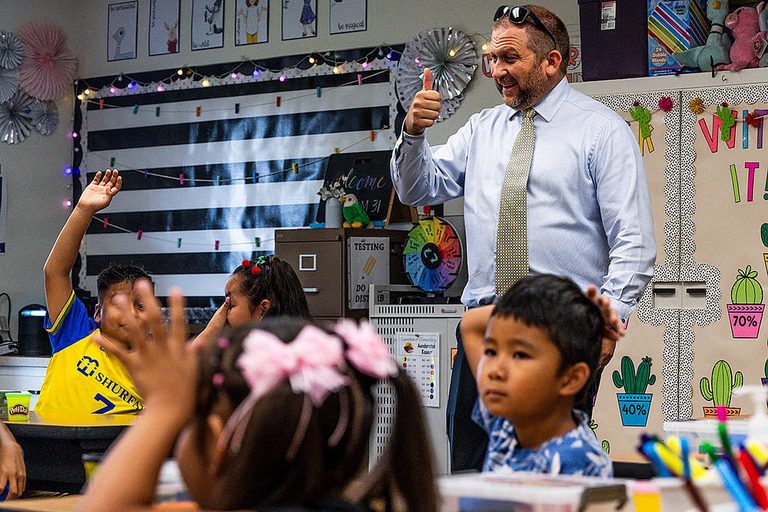
When Joel Francik took the helm at Central Elementary School in 2019, his background was rooted in middle‑school teaching and administration. He soon realized he knew little about how the youngest learners – pre‑K through third grade – actually develop. That gap caught the eye of new district superintendent Kristi Dominguez, whose career began in early‑childhood education.
Red flags and a rapid response
Dominguez toured Francik’s kindergarten classrooms and saw rows of desks and worksheets, a model more suited to older students. “We had desks in rows,” Francik confirmed. The district’s Transition to Kindergarten program also kept four‑year‑old classes isolated in separate buildings, prompting Dominguez to label the setup a “red flag.” Determined to change the culture, she ordered a district‑wide overhaul.
Year‑long P‑3 Leadership Program
All six Ferndale elementary principals entered the National P‑3 Center’s nearly year‑long leadership training, which focuses on child development and early learning. The program, originally launched at the University of Washington in 2013 and now hosted by the University of Colorado Denver, equips school leaders with research‑backed strategies for pre‑K to third‑grade classrooms.
“Most school leaders go through preparation programs that don’t talk about child development,” said Kristie Kauerz, founding executive director of the National P‑3 Center. “The result is leaders who take the same approach to kindergarten as they do fourth grade.”
Play‑based learning takes center stage
During the ten‑month (now seven‑month) training, Francik experienced a “lightbulb” moment when he learned that play is the work of children. Play‑based learning lets kids practice math concepts, develop communication skills, negotiate social situations and refine fine‑motor abilities through coloring and building.
Today, Francik’s kindergarten rooms have no individual desks. Students gather at tables, moving freely and choosing activities that match their interests. “We are not desks in rows anymore,” he said. “We have academics still, just not in rows. There’s lots of movement, lots of choice.” Each pre‑K through second‑grade class now includes a dedicated hour for child‑directed exploration, followed by a group reflection.
Impact spreads beyond Ferndale
Next year, Central Elementary will extend the model to third graders, allowing early‑grade practices to shape the entire school. A similar shift is occurring in Chicago Public Schools, where principal Joyce Pae joined the Building Early Learning Leaders (BELL) program offered by VOCEL, a local early‑learning nonprofit.
VOCEL launched BELL after the city’s universal pre‑K rollout revealed many elementary leaders felt unprepared. “We started hearing ‘I don’t feel equipped for pre‑K,’” said Jesse Ilhardt, VOCEL’s executive director. “Leaders were hungry for preparedness earlier than the district could provide it.”
Through one‑on‑one coaching, Pae discovered that what looks like simple play actually drives social‑emotional growth and embeds math and literacy concepts. She also learned that over‑reliance on smartboards for storytime can hinder critical developmental skills such as turning pages and tracking left‑to‑right reading.
Why early‑grade focus matters
Research shows that strong early‑grade instruction correlates with better long‑term academic outcomes. By equipping principals with a deep understanding of child development, districts can ensure that school culture supports the whole child, not just test scores.
Dominguez’s decisive action illustrates how a committed superintendent can turn a district’s early‑learning approach from a peripheral concern into a central pillar of school life, benefitting families, teachers and the broader community.
Original reporting: KRDO (Colorado Springs metro) — read the source article.