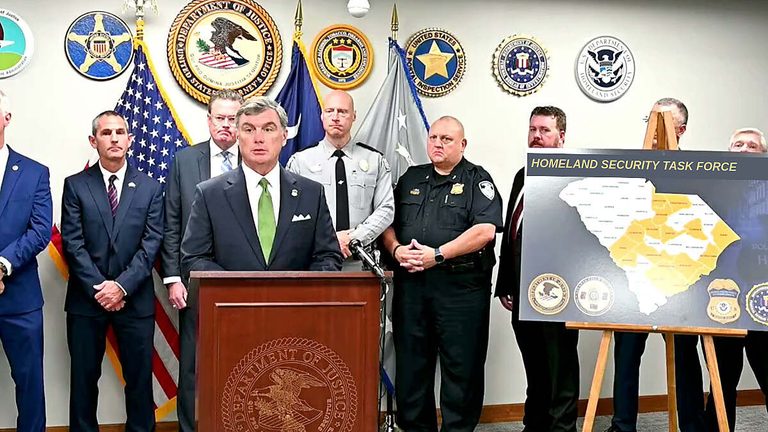
Federal authorities announced Tuesday that a sprawling drug trafficking operation, linked to Mexico’s Sinaloa Cartel, used inmates in South Carolina prisons to coordinate narcotics shipments across the United States. The investigation, which spanned the Midlands, Lowcountry, Pee Dee and Grand Strand, also reached into Georgia, North Carolina, California, Arizona, Arkansas and Ohio.
Prison phones enable a nationwide drug pipeline
U.S. Attorney Bryan Stirling explained that incarcerated brokers, many housed in the South Carolina Department of Corrections, used illegal cellphones to arrange sales with distributors outside prison walls. These inmates communicated with cartel leaders in Mexico, stash‑house operators and couriers throughout the state, then repackaged and redistributed fentanyl, cocaine and methamphetamine to street dealers.
“These people are arrested, they’re sent to prison, and they continue their criminal ways from behind bars,” Stirling said, emphasizing the need to block contraband communications.
Scope of the seizure
According to a Department of Justice release, investigators seized:
- 346 kg of fentanyl
- 23 kg of methamphetamine
- 70 kg of cocaine
- 34 lb of marijuana
- 43 firearms
- More than $2.8 million in cash
- 15 luxury vehicles, including two Rolls‑Royces, a Lamborghini and an Aston Martin
- Jewelry and pending lawsuits against 17 properties valued at nearly $4 million
The DEA’s Michael Tooley noted that the 156‑lb fentanyl seizure in July 2025 remains the largest ever recorded in South Carolina.
Charges and legal proceedings
The case resulted in 36 federal defendants. An April 2026 indictment initially charged 18 individuals; a superseding 42‑count indictment added 16 more, and two additional defendants were charged in a July 2025 indictment. Six defendants have already pleaded guilty, including two truck drivers sentenced for transporting 156 lb of fentanyl.
Potential penalties range up to life imprisonment for repeat offenders. The Justice Department also identified nine defendants who were unlawfully present in the United States.
Law‑enforcement response and future steps
Stirling, former director of the South Carolina Department of Corrections, called for stronger measures to jam illegal cellphone signals inside prisons. He cited an upcoming Federal Communications Commission vote on prison‑cellphone jamming technology and expressed optimism about its passage. Richland County Sheriff Leon Lott voiced support for the effort, noting that cutting off inmate communications would make it harder for criminal networks to operate from behind bars.
The investigation remains ongoing, with Assistant U.S. Attorneys Mike O’Mara and Cole Shannon leading the prosecution. Federal, state and local agencies—including the DEA, Homeland Security Investigations, FBI, South Carolina Law Enforcement Division, the Department of Corrections, State Transport Police and numerous local law‑enforcement partners—provided investigative assistance.
Community impact
The crackdown highlights the persistent threat that contraband phones pose to public safety and underscores the importance of coordinated law‑enforcement efforts across jurisdictions. Residents of South Carolina’s affected regions can expect continued vigilance as authorities work to dismantle remaining elements of the network and pursue asset forfeiture actions against properties tied to drug proceeds.
Original reporting: FITSNews — read the source article.