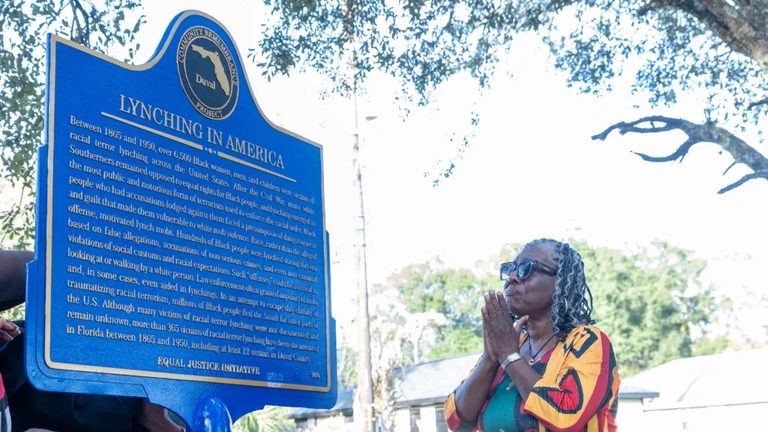
On Sunday afternoon a crowd gathered under an oak tree in Grand Park, Jacksonville, to unveil a new historic marker honoring Benjamin Hart, a Black man who was lynched on August 24, 1923. The marker, funded by the Equal Justice Initiative, the Jacksonville Community Remembrance Project and 904Ward, provides both the known facts of Hart’s death and broader national context about racial terror in America.
Family members share the truth after generations of myth
Samelia Adams, a great‑great‑granddaughter of Hart, explained that her family had been told for decades that her ancestor abandoned them. “My grandmother told my mother that his father went to work and never returned,” Adams said. “Now we finally have the truth and can honor Benjamin Hart for the rest of my life.”
Adams, a Jacksonville native and Robert E. Lee High School graduate, grew up hearing warnings about men like Hart. As a grandmother, she hopes the marker will end the false narrative that has haunted her family for generations.
Descendants, historians and clergy attend
Four of Hart’s descendants were present: Adams, great‑granddaughter Michelina Smith, great‑great‑granddaughter T’Mia Hopkins and great‑great‑grandson Joseph Terrell. Terrell reflected on the loss of family memory, saying, “We can’t get back the stories that were never told, but we can make sure his name is no longer forgotten.”
Local historian and Florida State College at Jacksonville professor Tim Gilmore noted that Hart lived on East 8th Street in what is now known as Durkeeville and worked in western Duval County. Gilmore, who maintains the Jax Psycho Geo website, said no one has ever been held accountable for Hart’s murder. “The facts did not matter to his killers,” he said.
The Rev. John Newman, pastor of The Sanctuary at Mt. Calvary, reminded attendees that lynchings were tools of intimidation and forced silence, often sparked by accusations from white women. “We must never confuse the discomfort of confronting history with the harm of living through it,” he urged.
Mayor engages with community concerns
Following the ceremony, Jacksonville’s mayor addressed a predominantly Black audience, listening to requests to remove a Confederate monument from a public park, reduce blight in Black neighborhoods and improve educational opportunities for young children. The mayor’s willingness to hear these concerns was noted as a hopeful sign of responsive local leadership.
Recent tragedy underscores need for remembrance
Two days after the unveiling, a white supremacist opened fire at a Dollar General store near Kings Road, killing three people. The Equal Justice Initiative and the Jacksonville Community Remembrance Project typically collect soil samples at lynching sites around the anniversary; the marker ceremony was moved to November out of respect for the shooting victims.
Terrell emphasized the broader lesson, saying, “We have to start paying closer attention to one another, to our families, to our neighbors and, especially, our children. That responsibility doesn’t stop with our community—it belongs to everyone.”
Why the marker matters
The marker’s west side lists Hart’s age (34), the date of his death and the location where his bullet‑riddled body was found in a ditch along Kings Road near Penton Street. The east side explains the prevalence of lynchings across the United States and the ongoing effort to document and remember each victim.
Jacksonville Community Remembrance co‑chair Lynn Sherman said the project’s hope is that these markers will bring healing and education, allowing residents to look back honestly and move forward together.
Original reporting: Jacksonville Today — read the source article.