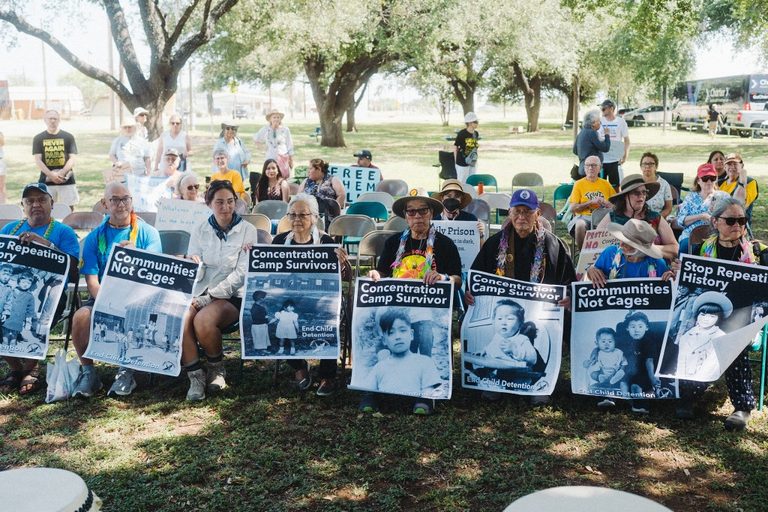
A group of faith leaders, Japanese internment survivors, and their descendants completed a four-day, 45-mile pilgrimage to the South Texas Family Residential Center in Dilley, Texas, to demand its closure. The facility, which is the nation’s only immigrant detention center that imprisons parents with their children, has been the site of intense protests and criticism.
Protest and Pilgrimage
The pilgrimage, organized by Free Families, a national coalition of organizations advocating for immigrant families, aimed to raise awareness about the inhumane conditions at the facility and to call for an end to family detention. The group, which included survivors of Japanese internment camps and their descendants, walked up to 12 miles each morning, carrying paper cranes and wearing traditional clothing.
Upon arrival at the facility, the group held a ceremony, where they prayed, delivered a meditative chant, and tied chains of multicolored origami cranes to the facility’s 10-foot chain-link fence topped with razor wire. The paper cranes were folded by Japanese American concentration camp survivors and their descendants.
Conditions at the Facility
The Dilley facility has been criticized for its inhumane conditions, including moldy, worm-ridden food and neglectful medical care. The facility has also reported cases of measles, and protesters have clashed with authorities outside the facility. In January, authorities used tear gas and pepper ball grenades on hundreds of faith leaders, advocates, and residents, resulting in two arrests.
For survivors of Japanese internment, the Dilley facility hearkens to the U.S. concentration camps that shuttered 80 years ago. Rev. Kenji Akaposhi, a retired Buddhist minister and survivor of Japanese internment, told pilgrims, ‘I was 2 weeks old when my family was incarcerated. Because of that trauma that I suffered — that has been with me my entire life — I am here to help those, especially the children, whose lives are being affected as we speak.’
Original reporting: Texas Tribune (HLL/CB) — read the source article.