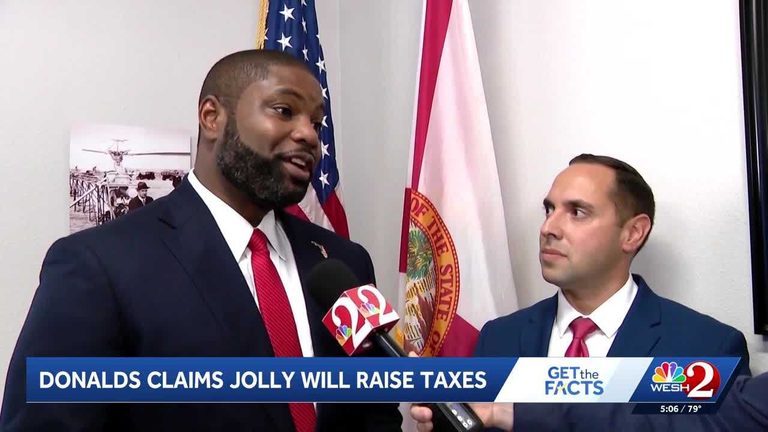
In a recent television spot, the campaign of Republican candidate for governor Byron Donalds warned voters that Democratic nominee David Jolly would increase taxes on everyday Floridians – from restaurant servers to retirees on Social Security. While the ad’s emotional narrative paints a picture of hard‑working families under threat, the factual record shows the claims are misleading.
What the ad says
The commercial, produced by the “Friends of Byron Donalds” political committee, opens with a diner scene and a narrator stating, “You wait tables to make ends meet, and David Jolly wants to tax you more for it.” It repeats the message for overtime workers and Social Security recipients, concluding that Florida “can’t afford” liberal policies.
Jolly’s actual position on taxes
David Jolly, a former Republican congressman who switched parties, has publicly acknowledged support for taxing wages, including tips and overtime, but he also said he would back relief for tips that exceed the standard wage rate. This admission is accurate, yet the ad fails to note a crucial limitation: the governor of Florida does not have authority to impose a state income tax.
Florida currently has no state income tax, and any new tax on wages, tips, overtime or Social Security benefits would require legislation passed by the state legislature and a constitutional amendment. As such, even if Jolly were elected governor, he could not unilaterally raise those taxes.
Donald’s tax‑cut record
During his tenure in the U.S. House, Byron Donalds voted for the One Big Beautiful Bill Act (H.R. 1), signed by President Donald Trump on July 4, 2025. The legislation cut taxes on overtime and tipped wages, but it also reduced funding for the Supplemental Nutrition Assistance Program and Medicaid. The bill passed by a single vote, 215‑214, and its tax deductions are limited: they apply only to the “half” of time‑and‑a‑half overtime, exclude union‑contract work, and cap tipped‑wage deductions at $25,000 for specific occupations. Those benefits are set to expire in 2028 unless Congress extends them.
Social Security claim debunked
The ad’s final assertion – that Jolly would raise taxes on Social Security – is also false. While Jolly served in Congress from 2014 to 2017, the Congressional Record shows he never voted for a measure that would increase Social Security taxes. Moreover, the governor lacks any power to alter federal Social Security tax rates.
Attendance records
Both candidates have faced criticism for missed votes while serving in the U.S. House. GovTrack data indicates Donalds missed 158 of 2,756 roll‑call votes (about 5.7%) from January 2021 through April 2026. Jolly missed 77 of 1,763 votes (4.4%). The average missed‑vote rate for House members is 2.1%.
What voters should know
Florida voters should focus on the substantive policy differences between the two candidates rather than the emotive claims of a campaign ad. While Donalds emphasizes tax cuts for workers, those cuts are limited in scope and duration. Jolly’s willingness to tax wages is clear, but any such tax would require legislative action beyond the governor’s office.
Understanding the constitutional constraints on state taxation helps voters assess the real impact of each candidate’s platform on families, small businesses, and retirees across the Sunshine State.
Original reporting: WESH Orlando — read the source article.