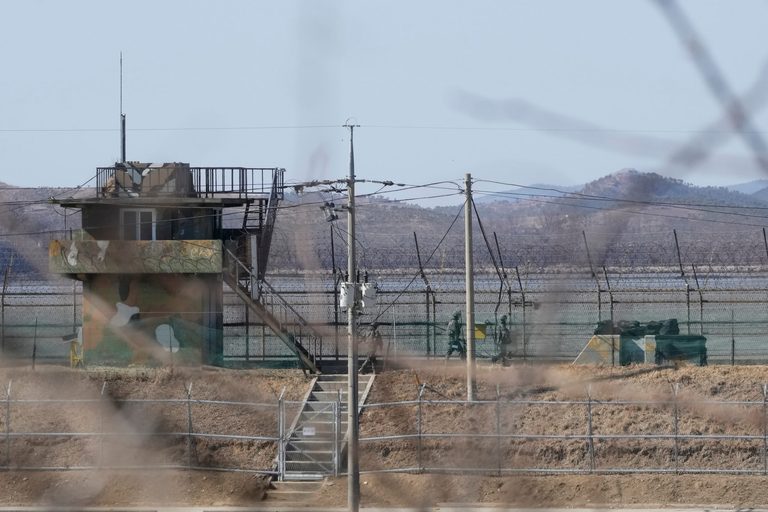
Seoul – An explosion in the heavily fortified Demilitarized Zone (DMZ) on Monday injured three South Korean military officers, the Defense Ministry said. The blast occurred during an unspecified operation inside the buffer zone that separates the two Koreas.
Details of the incident
According to the ministry, two of the wounded officers were airlifted from the site by helicopter, while the third was first moved by ground transport before being evacuated by air. All three are receiving treatment at a military hospital near Seoul.
The cause of the explosion remains unclear. Officials have not confirmed whether a North Korean‑planted land mine was involved, though the North has added numerous mines and anti‑tank barriers to its front‑line defenses in recent months as relations have sharply deteriorated.
Context of heightened border activity
The DMZ, a 248‑kilometer (155‑mile) long and 4‑kilometer (2.5‑mile) wide strip, is one of the world’s most heavily armed borders, littered with an estimated two million mines, barbed‑wire fences, tank traps and combat troops on both sides. While the Korean War ended in 1953 with an armistice, no peace treaty was ever signed, leaving the peninsula technically at war.
South Korean officials have warned of increased North Korean activity near the Military Demarcation Line (MDL). Media reports suggest North Korean soldiers crossed the MDL more than 20 times during August alone, though the ministry has not officially confirmed those figures.
In April 2025, South Korean forces fired warning shots to repel about ten North Korean soldiers who crossed the eastern section of the DMZ. The intruders withdrew after audio warnings and the shots were fired, and no clashes occurred. Similar incursions were recorded in June 2024, prompting South Korean warning fire.
Broader security implications
North Korean leader Kim Jong Un has, in recent years, suspended virtually all diplomatic cooperation with Seoul, labeling South Korea as his most hostile adversary amid stalled nuclear negotiations with Washington. The continued buildup of mines and other fortifications raises the risk of accidental detonations that could harm military personnel or civilians.
Historically, North Korean mines have occasionally been swept downstream into South Korean territory, causing civilian casualties. In August 2015, land‑mine blasts injured two South Korean soldiers and heightened tensions between the two nations.
Official response
The Defense Ministry emphasized that the injured officers are receiving appropriate medical care and that investigations are underway to determine the cause of the explosion. South Korean authorities continue to monitor the DMZ closely, maintaining a high state of readiness to protect the nation’s sovereignty and the safety of its service members.
As the peninsula remains a flashpoint for regional security, the incident serves as a reminder of the fragile peace that persists along the DMZ and the importance of vigilant defense measures.
Original reporting: Alexandria, VA News – WTOP News — read the source article.