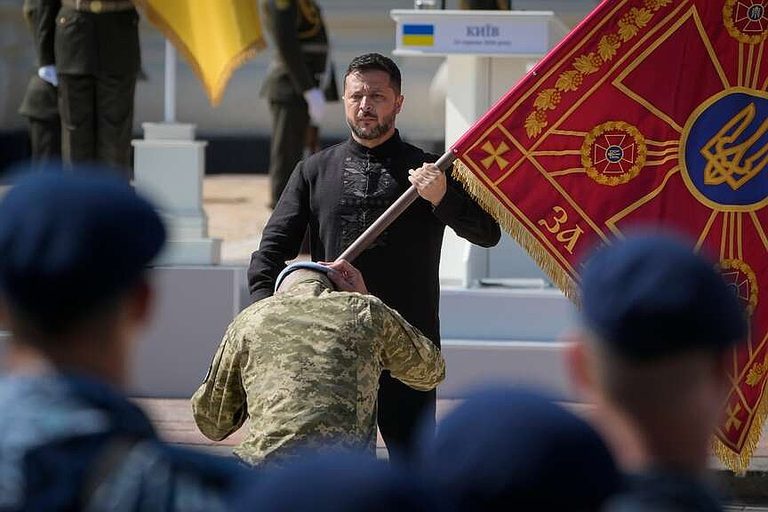
On Monday, Kyiv hosted a gathering of European leaders alongside President Volodymyr Zelenskyy to commemorate the 35th anniversary of Ukraine’s independence. The ceremony highlighted the continent’s continued support for Ukraine as Russia’s four‑year‑old invasion shows no sign of abating.
European solidarity and new defense commitments
U.K. Prime Minister Andy Burnham, on his first overseas trip since assuming office, co‑chaired a meeting of the so‑called “Coalition of the Willing,” a group of more than two dozen nations providing assistance to Ukraine. Burnham announced that the British government will permit defense contractor MBDA to share classified information about British components used in the SCALP long‑range missile, a step that could enable France and Ukraine to begin local production of the weapon.
Burnham also urged other allies to press Washington for tougher sanctions on Russia and to support U.S. efforts to secure an unconditional ceasefire. “Ukraine has been Europe’s protector, not a drain on our security,” he said, emphasizing the strategic importance of keeping pressure on Moscow.
Zelenskyy stresses the need for continued aid
Speaking from Kyiv’s St. Sophia Square, President Zelenskyy said the presence of European dignitaries underscored continental concerns about Russia’s broader ambitions. He warned that no nation could withstand the intensity of the current attacks without the world’s help and that the war’s outcome will affect the future of Eastern Europe as a whole.
Ukrainian Foreign Minister Andrii Sybiha echoed the sentiment on social media, noting that independence is not an abstract idea but a reality defended against overwhelming odds.
Military developments on the ground
Ukraine continues to rely heavily on NATO partners for advanced weaponry. The country has made notable progress with domestically produced drones capable of striking targets up to 2,000 km inside Russia, including oil facilities and the online retailer Wildberries. Finnish President Alexander Stubb described such strikes as a “sensible military strategy” that could accelerate peace talks.
However, Ukraine’s stock of Patriot interceptors is dwindling, and officials warn that a shortage before winter could leave the nation vulnerable to Russia’s seasonal bombardments of its power grid.
Russian retaliation and civilian toll
Russia reported intercepting 351 Ukrainian drones across eight regions and the Crimean Peninsula. It also claimed to have struck Ukrainian ports and vessels carrying military cargo. In recent days, Russian attacks have hit civilian targets, including a shopping center in central Ukraine that killed 16 people and wounded 130.
In the Russian city of Krasnodar, three teenagers were killed and six children wounded after Ukrainian strikes hit warehouses belonging to the online retailer Ozon. Additional attacks were reported on Ozon facilities in the Adygeya region.
International dynamics
The Kremlin condemned the European leaders’ involvement, with spokesman Dmitry Peskov describing the British actions as “extremely negative” and accusing the U.K. of taking part in the war on Kyiv’s side. Meanwhile, Russia continues to receive assistance from North Korea and China, further complicating the geopolitical landscape.
As the conflict enters its fifth year, both sides remain locked in a cycle of aerial attacks that damage infrastructure and cause civilian casualties. While diplomatic efforts continue, the international community’s material support for Ukraine appears to be a decisive factor in the ongoing struggle.
Original reporting: Texarkana Gazette — read the source article.