At a Wednesday council meeting, Eugene officials examined how the city might change its sidewalk repair system, which currently places the cost and responsibility on property owners. The discussion highlighted pilot programs that aim to make repairs more affordable and the staffing constraints that limit the city’s ability to act quickly.
Current repair rules place the burden on owners
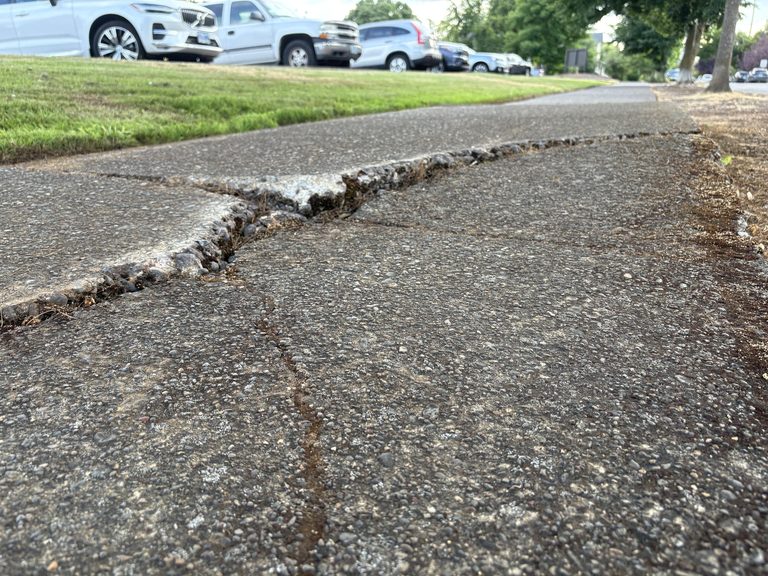
Under Eugene’s municipal code, the owners of properties abutting a sidewalk are required to keep that sidewalk in “good repair and safe condition.” City staff told councilors that the rule is common across the United States but is little‑known, and many residents find the expense prohibitive. “It’s not the city, but property owners who are expected to repair sidewalks under city code, even when there’s a city street tree involved,” said Jody Trendler, senior transportation planner with Public Works Engineering. Repairs can run into the thousands of dollars, making them unaffordable for many families.
Sidewalk conditions are deteriorating
A 2023 survey of 20 acres of Eugene sidewalks, conducted by University of Oregon students, found that only 45% of sidewalks earned a rating of “good” or “very good.” The survey measured factors such as height differences, slope, width and obstructions. Councilor Alan Zelenka warned, “The sidewalk system is just not in good shape anymore,” noting numerous ADA (Americans with Disabilities Act) concerns in his Ward 3.
Enforcement relies on complaints and a single inspector
Residents must file a complaint to trigger an inspection. If a deficiency is found, owners may obtain a permit, hire a private contractor, or use a city crew and be reimbursed. In 2023 the Public Works Maintenance division logged 622 service requests, issuing 269 work orders, 280 deficiency notices and completing 71 city‑performed repairs. The following year, 544 inspection requests were recorded. Katie Marwitz, the city’s principal civil engineer, explained that the department employs only one sidewalk inspector, who must travel to every request site. Urban forestry staff, who handle repairs involving tree roots, would need to add roughly one‑third of a full‑time employee to meet current demand.
Pilot programs offer discounted repairs
One pilot, funded by a 2022 bond measure, bundles sidewalk repairs with ongoing street projects. Since 2025, the city has completed 21 such repairs, on top of the 71 performed by Public Works Maintenance. Marwitz reported that property owners saved an average of $1,400 per repair compared with standard rates. The program is slated to continue through 2027 and will expand to include sidewalks adjacent to streets being paved.
A low‑income subsidy program also provided discounted repairs to two qualified owners in 2025, covering base mobilization costs of about $1,800 per job. Additionally, Public Works completed 250 sidewalk grinds—removing uneven grades caused by tree roots or soil movement—across 13 city parks between 2024 and 2025.
Planning for longer‑term solutions
A working group of staff from Urban Forestry, Public Works Maintenance and Engineering meets monthly to brainstorm ways to increase repair capacity within existing resources. The group is also reviewing transportation system assessments that will inform future sidewalk strategies. City Manager Jenny Haruyama said recommendations are expected within two years, noting that there is “no one magic button solution” but many viable ideas.
Councilor Matt Keating asked whether the city’s repair rates are high enough to allow the municipality to take on more work without losing money. Marwitz said the city is moving toward a full‑cost recovery model and may explore cost‑sharing arrangements with residents. Councilor Eliza Kashinsky emphasized the need for clear revenue projections before committing to reforms.
Community input and next steps
Volunteer group Community United to Repair our Broken Sidewalks (CURBS) has been advocating for change. Member Mary Christensen noted that the Whiteaker and Jefferson Westside neighborhoods show the poorest sidewalk conditions, a finding supported by the university data. CURBS welcomes the pilot programs and urges the city to evaluate total sidewalk spending, consider cost‑sharing models, and look to regional examples such as Corvallis’ Sidewalk Safety program.
As the council continues its review, officials stress that any new funding or policy options will need to be balanced against other municipal priorities, including street maintenance and broader transportation needs.
Original reporting: Homepage – Lookout Eugene-Springfield — read the source article.