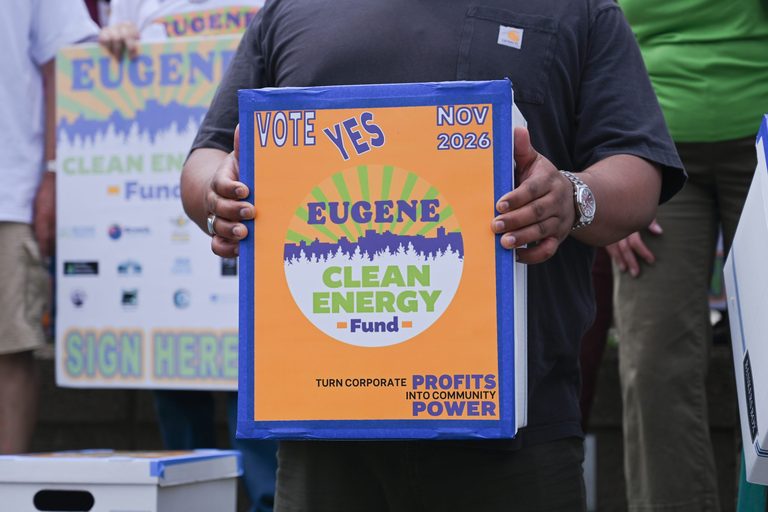
Residents of Eugene have been following Measure 20‑388, the Eugene Clean Energy Fund, since its registration in February. While local outlets have done solid reporting, three important gaps remain that voters need to understand before heading to the polls.
Gap 1 – The “hidden sales tax” claim is false
Opponents, including Oregon Business & Industry and the Northwest Grocery Retail Association, have called the measure a “hidden sales tax” that would be passed on to shoppers. The certified measure text defines the fee on “gross profits,” which is sales revenue minus cost of goods sold. In other words, the fee is a 2 % charge on profit, not on total sales.
For a high‑volume, low‑margin business such as a grocery chain, a profit‑based fee is far smaller than a 2 % tax on gross sales. Calling it a sales tax erases that distinction and inflates the perceived cost to ordinary consumers. This is not a technicality; it is a substantive mischaracterization that serves as a scare tactic rather than an accurate description.
Gap 2 – Oversight committee composition was misstated
Earlier reporting described the fund’s oversight body as an “elected nine‑member committee of Eugene residents.” The measure actually requires two members to be a city councilor and an EWEB board member, one appointed by the Sustainability Commission, one by the Human Rights Commission, and the remaining five selected from an applicant pool by city councilors. While the error does not change the fee’s economic impact, it matters for transparency about who makes allocation decisions.
Gap 3 – Missing broader context of corporate tax fairness
The most significant omission in local coverage is the connection between Measure 20‑388 and a long‑standing corporate tax shift in Oregon. The Oregon Center for Public Policy reports that the corporate share of state income taxes fell from about 18.5 % in the mid‑1970s to under 7 % today, largely due to loopholes and a low corporate minimum tax. Measure 20‑388 seeks to have billion‑dollar corporations pay a fairer share of the tax burden.
Nationally, the EPA’s recent repeal of the 2009 Endangerment Finding and the delay of methane rules have rolled back key climate protections, adding pollution equivalent to 25 million gas‑powered cars, according to the agency’s own estimates. Brookings notes that even industry leaders are uneasy about the regulatory instability, yet few have mounted a strong public challenge.
In Oregon, the same groups opposing Measure 20‑388—most notably Oregon Business & Industry—are also leading a lawsuit to overturn the state’s Climate Protection Program, arguing that compliance costs are too high for businesses. This broader corporate campaign against climate action underscores why local voters need a measure that restores fiscal balance and funds needed climate projects.
Why the measure matters for Eugene families
By directing a modest profit‑based fee to the Clean Energy Fund, Eugene can raise reliable money for climate‑resilient infrastructure, renewable energy projects, and community‑wide sustainability initiatives. The fund’s design mirrors Portland’s Clean Energy Fund, which raises over $200 million annually for similar purposes.
For families who value responsible stewardship of resources and who want to see their children grow up in a healthier environment, supporting Measure 20‑388 aligns with both traditional family values and the constitutional principle of local self‑determination.
What voters should consider
- The fee is on profit, not sales, so it does not function as a hidden sales tax.
- The oversight board includes appointed officials, ensuring experienced oversight.
- The measure addresses a decades‑long decline in corporate tax contributions, helping to rebalance the tax burden.
- It provides a local funding source for climate resilience at a time when federal protections are being rolled back.
As the ballot deadline approaches, voters are encouraged to review the certified measure text and weigh the factual clarifications presented here. Accurate information is essential for making an informed decision that protects both the environment and the economic well‑being of Eugene’s families.
Original reporting: Homepage – Lookout Eugene-Springfield — read the source article.