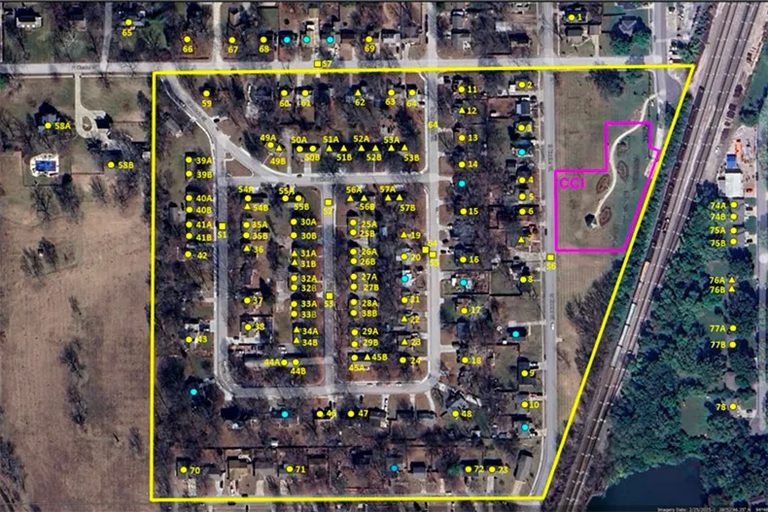
Residents of Olathe’s neighborhoods surrounding the former Chemical Commodities plant at 320 S. Blake St. have learned that the EPA’s latest assessment finds the site’s groundwater cleanup still inadequate. The September 2026 report states that current mitigation measures are “not currently protective of human health and the environment.”
Background on the site
From 1951 to 1989, Chemical Commodities handled, stored, and repackaged a variety of industrial chemicals. After the company closed, the property was transformed into the Pollinator Prairie, a green space now surrounded by residential homes. Initial cleanup removed contaminated soil and installed a protective cover over the remaining waste. While the cover remains in good condition, chemicals beneath it continue to leach into the groundwater and migrate beneath nearby houses.
Current health concerns
The EPA identified trichloroethylene (TCE) as a primary contaminant of concern. TCE vapors can travel through soil cracks and enter homes, raising indoor‑air concentrations. The agency’s report notes that TCE levels are “not adequately controlled” and have been detected in indoor air samples. According to the Centers for Disease Control and Prevention, high exposure to TCE can damage the liver, kidneys, and nervous system, with risk depending on exposure duration and concentration.
EPA’s past actions and recent findings
In 2002, after discovering elevated chemical concentrations in crawl spaces and indoor air, the EPA, with assistance from responsible parties—including Boeing—installed home ventilation systems to reduce exposure. The agency assumed maintenance of those systems in 2008. A 2021 EPA evaluation deemed the ventilation systems effective in the short term but warned that without a functional groundwater remedy, indoor‑air risks could grow.
Since that 2021 warning, the EPA has intensified its outreach. Of the 156 homes contacted last year, 107 granted access for inspection. Inspectors found 15 ventilation units in need of critical repairs and identified eight homes that lack systems entirely. The agency now plans to continue testing and to complete a study of alternative cleanup options by October 2028.
What residents can do
Until a more permanent solution is in place, the EPA advises homeowners to keep existing ventilation systems operating continuously. Residents are also encouraged to stay informed about upcoming testing schedules and to report any new indoor‑air concerns to the agency.
Looking ahead
The original EPA estimate projected a 100‑year timeline for groundwater remediation. New modeling suggests the process could extend to several hundred years because chemicals trapped in rock formations slowly release back into the water supply. The agency’s commitment to further study and to explore additional remediation techniques reflects an ongoing effort to protect Olathe families from harmful exposure.
Original reporting: Johnson County Post (Overland Park) — read the source article.