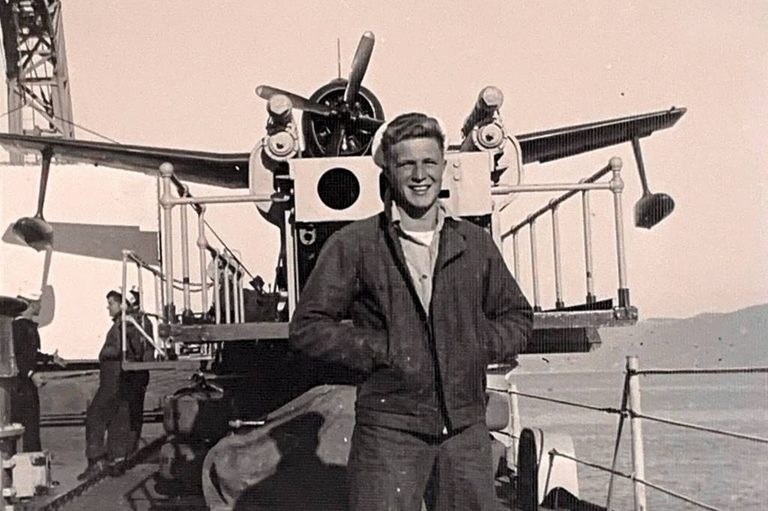
Enumclaw resident and registered nurse Aaron Avery has taken on the role of family historian, opening a dusty box of letters, postcards and photographs that span more than a century. The collection, which includes correspondence from his uncle, Seaman First Class Charles Raymond “Ray” Fenton, offers a rare, ground‑level view of life aboard the light cruiser USS Fargo (CL‑106) during its 1946‑1948 Mediterranean deployment.
Letters from the deck of the USS Fargo
Ray enlisted in May 1946, completed boot camp in San Diego and soon found himself sailing from the West Coast to Italy, Greece, France, Malta and other ports. His letters, written in careful cursive on official USS Fargo letterhead, describe the excitement of a young 18‑year‑old sailor far from his hometown of Hoquiam, Washington. “Homesick and funny,” Avery says, “trying to sound grown up.”
One December 15, 1956 letter from Naples captures the simple longing of a serviceman awaiting Christmas: “Gee it sure doesn’t seem like Xmas is only 10 days away. It sure won’t be much of a Xmas being over here, but maybe next Xmas I will be home… I won’t open them til Xmas, but I sure would like to know what you sent.” A later note from Rome recounts a brief visit to St. Peter’s Church, praising its beauty while promising to share photos upon his return.
Making history accessible
Starting November 11, the letters will be posted serially on the dedicated website thefargofiles.com, free to the public. Avery hopes the project will encourage other families to rescue similar boxes before they are discarded. “Boxes like this one are disappearing every year when families clean out houses. Every one that survives is a primary source nobody has to interpret secondhand,” he explained.
In addition to the letters, Avery is offering a curated collection of vintage items for sale, primarily postage stamps ranging from 19th‑century issues to early U.S. airmail, as well as assorted historical paper and ephemera. Among the listings are a 1861 “Bergedorf 4 Shilling” stamp, described as potentially the most important single stamp in the collection, and a November 7, 1918 edition of the Yerba Buena Gazette that mistakenly announced Germany’s surrender four days early.
Future chapters
After Ray’s correspondence is fully published, Avery plans to turn his attention to a second archive: letters from Ray’s brother Bud, who also served during World II, as well as a 1927 family road‑trip diary and stories of his ancestors’ lives in the timber country of Humptulips and Grays Harbor from the 1880s through the 1920s.
The project blends personal heritage with broader historical insight, showing how ordinary sailors experienced the post‑war world and how their families kept the home front connected across oceans. By sharing these documents, Avery not only honors his uncle’s service but also provides a tangible link to a pivotal era in American naval history for the Enumclaw community and beyond.
Original reporting: Renton Reporter — read the source article.