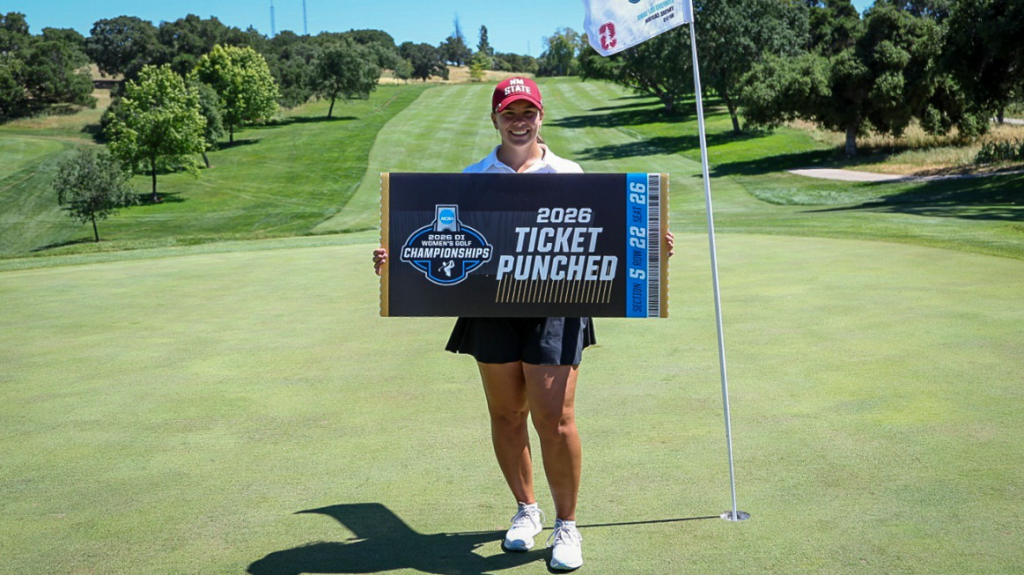
Emma Bunch of Las Cruces, New Mexico turned heads at the NCAA Stanford Regional, finishing as the top individual from a non-qualifying team after three rounds at Stanford Golf Course. She shot six-under overall and earned an individual berth to the 2026 NCAA Women’s Golf Championship, which begins May 22 in Carlsbad. The performance gives Bunch a clear personal victory on a weekend where team hopes didn’t advance, and it puts her squarely on the national stage for the spring finale.
Bunch’s three-day stretch at Stanford Golf Course showed steady, composed golf under pressure, and that steadiness is the thread running through her week. Playing as an individual separates routine from heroics because there’s no team cushion, so every decision, every putt and every tee shot belonged to her alone. That kind of responsibility can flatten players or sharpen them, and in Las Cruces’ case it sharpened Emma into someone who will compete with the best in Carlsbad.
There’s a practical side to what she accomplished: earning an individual qualifier spot at the NCAA Women’s Golf Championship means she will face courses and competitors chosen by committee but bound to be elite, and she’ll do it carrying momentum. Momentum in college golf is subtle; it’s not just the scorecard but the confidence that you can grind through cold putts and gusty winds, and a week like Stanford gives that proof. Coaches and fans in Las Cruces will watch because individual qualifiers often leave a mark by making opponents adjust their strategy to account for a fearless competitor.
For New Mexico State’s program and for the Las Cruces community, Bunch’s run is a reminder that individual talent can push a program into broader conversations even when the team result doesn’t. Individual qualifiers represent their schools and hometowns alone, and that spotlight can translate into recruiting buzz, local support and renewed energy in practice rooms back home. That ripple matters: a single player at nationals brings attention that can lift a program’s profile and attract players who want similar chances to shine on a national stage.
Technically, the shift from Stanford Golf Course to the courses likely used in Carlsbad means adapting to different turf, wind patterns and strategic choices, and Bunch will have to refine her approach quickly. The tournament setup in Carlsbad tends to reward course management and short-game creativity, so fine-tuning wedges and putter feel will be high on the checklist between now and May 22. Her Stanford performance showed she can manage the scoreboard; now she’ll need to translate that into the kind of nuanced play that wins low-scoring events at nationals.
There’s also a psychological angle: qualifying alone strips away the safety net and exposes players to a higher-stakes spotlight, and how she handles that will say a lot about her next steps. College golf produces a lot of talented players, but the ones who thrive at nationals pair technical skill with a temperament that stays even when the gallery tightens and leaders change each hour. Emma Bunch’s ability to stay composed through three rounds at Stanford suggests she understands that balance, and Carlsbad will test her on a bigger stage with deeper fields.
Practically speaking, the lead-up to the NCAA Women’s Golf Championship will be about sharpening short game, rehearsing course management plans and dialing in mental routines that worked at Stanford. Expect practice days to be structured around pressure simulations and recovery between rounds, because staying fresh for each 18 is as important as anything you can do on the range. Whatever adjustments she and her coaches choose, the core fact remains: Bunch is going to Carlsbad, she earned it with six-under at Stanford, and she’ll carry Las Cruces into the national conversation as one of the individual competitors to watch.