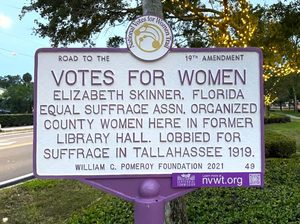
In a heartfelt gathering at Dunedin’s Edgewater Park, residents and civic leaders came together to honor Elizabeth Skinner, a pivotal figure in Florida’s suffrage movement. The event, ‘Celebrating Local Suffragist Elizabeth Skinner,’ was marked by the unveiling of a National Votes for Women Trail marker, commemorating her significant contributions to expanding voting rights in the state.
Local Impact and Legacy
Elizabeth Skinner, a prominent leader in the early 1900s, played a crucial role in advocating for women’s voting rights in Florida. As a member of the Florida Equal Suffrage Association, she organized women throughout Pinellas County, tirelessly working to secure their right to vote. Her efforts included speaking at public meetings, distributing literature, and lobbying lawmakers, culminating in her 1919 trip to Tallahassee to support the ratification of the 19th Amendment.
Skinner’s influence extended beyond the suffrage movement. She served on the Dunedin City Commission and was the only woman on the Pinellas County School Trustee Board for several years. Her commitment to community development was evident in her involvement with local organizations like the YWCA and Boy Scouts, shaping the community long after women gained the right to vote.
Celebrating a Century of Progress
The event at Edgewater Park was attended by members of the League of Women Voters North Pinellas, West Pinellas National Organization for Women, and other local organizations. They gathered to not only honor Skinner’s legacy but also to inspire future generations to engage in civic life and exercise their voting rights.
Elizabeth Skinner’s contributions to Florida’s history are permanently recognized at Edgewater Park, where the National Votes for Women Trail marker stands as a testament to her enduring impact. Her legacy also lives on in the community through Elizabeth Skinner-Jackson Park, a neighborhood park that serves as a reminder of her dedication to civic engagement and community service.
Original reporting: St. Pete Catalyst — read the source article.