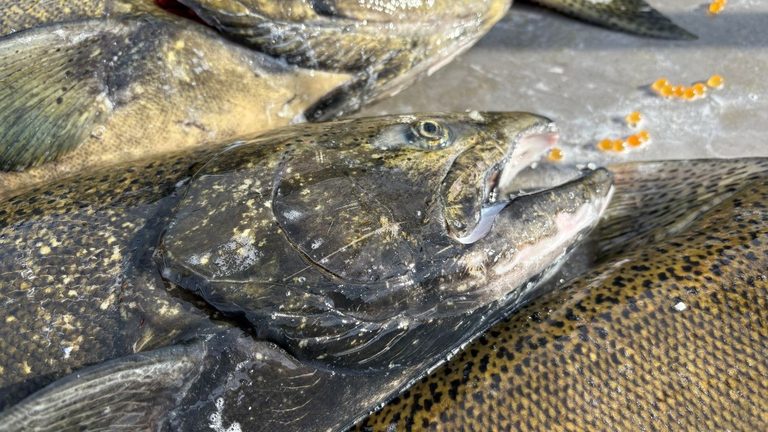
Door County, WI – The Department of Natural Resources (DNR) is in the midst of the Chinook salmon spawning run at the Strawberry Creek facility near Sturgeon Bay. Crews worked Monday morning to process dozens of salmon, collect eggs and gather biological data that will help sustain the sport‑fish population in Lake Michigan.
Egg collection and hatchery goals
Wild Rose State Fish Hatchery Supervisor Jesse Landwehr said the season is roughly half‑way complete. “We have about a million and a half eggs in the hatchery right now. We’re looking for another million to a million and a half eggs to meet our goal,” Landwehr explained.
Why the run matters
Chinook salmon were originally stocked into Lake Michigan in the 1960s, but they have struggled to reproduce without assistance. DNR Fisheries Biologist Logan Sikora described how the fish migrate up Strawberry Creek and become trapped in the hatchery’s concrete pond.
“The fish come swimming up Strawberry Creek and get stuck in our pond here,” Sikora said. “We crowd the fish to the end of the tank, then hoist them up onto the table for processing.”
Processing and data collection
During processing, each fish is humanely euthanized so technicians can record length, weight, sex and fin‑clip information. “We’ll take biological data from them. That includes the length, the weight. See what sex they are. Check for fin clips so we can assign an age to them or see if they’re a natural or stocked fish,” Sikora noted.
Health of the run
Overall, the salmon appear healthy, but Sikora observed a trend that anglers have reported all summer.
“We’re seeing what the anglers have been all summer. The fish are running smaller. There’s a lot out in the lake and a lot of mouths to feed, so they’re definitely running smaller than what a lot of people would like to see,” he said.
Next steps and community benefit
Landwehr expects the spawning run to wrap up by the end of next week. “All the eggs that we’re taking today will end up down at the Wild Rose Hatchery. They’ll be incubated, hatched, and reared there. Then next spring they will come back and be stocked as about three‑inch fingerlings into Strawberry Creek and other tributaries leading to Lake Michigan,” he explained.
Any salmon that are not used for stocking are redirected to local food pantries, wildlife rehabilitation centers, zoos, or are processed into fertilizer, ensuring that the fish provide value to the community even when they are not released back into the lake.
Supporting local anglers and ecosystems
The DNR’s effort reflects a broader commitment to maintaining a robust sport‑fishery that supports local anglers, tourism and the ecological health of Lake Michigan. By monitoring the run closely, officials can adjust stocking strategies and address concerns about fish size and population health in future seasons.
Original reporting: FOX 11 WLUK Green Bay (local) — read the source article.