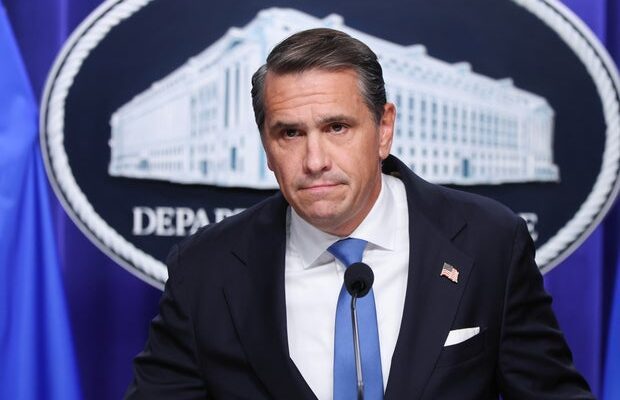
The U.S. Department of Justice has taken decisive action to protect the rule of law by filing a judicial misconduct complaint against two federal judges in Minnesota. Acting Deputy Attorney General Trent McCotter and Associate Attorney General Stanley Woodward signed the complaint, asserting that Judges Patrick Schiltz and John Tunheim used their positions to launch a partisan campaign against the Trump administration’s immigration enforcement effort, Operation Metro Surge.
Complaint details and administration’s rationale
According to the filing, Judge Schiltz, a former appointee of President George W. Bush who once clerked for Justice Antonin Scalia, and Judge Tunheim, appointed by President Bill Clinton, made public statements that the Justice Department says “flagrantly violated the Code of Judicial Conduct.” The complaint alleges that Schiltz’s remarks were “overly political” and addressed matters still pending before the courts, while Tunheim’s comments were deemed “equally unethical” despite being less verbose.
McCotter and Woodward wrote, “If anything is a grave threat to the rule of law, it is judges who repeatedly and brazenly exceed their authority then launch a partisan press campaign that includes criticizing the government for filing an emergency appeal when a judge refused to rule on a search warrant application.” The officials asked the 8th Circuit Court of Appeals to order the judges to recuse themselves from any cases involving the Department of Homeland Security and to investigate the alleged misconduct.
Context of Operation Metro Surge
Operation Metro Surge, launched by the Trump administration in December 2025, deployed more than 3,000 immigration enforcement officers to Minnesota to address illegal immigration and related public‑safety concerns. Border czar Tom Homan announced in February that the operation would be winding down, with a drawdown of federal officers planned.
The heightened enforcement led to several confrontations between federal agents and protesters. Two individuals, Renee Good and Alex Pretti, were killed in January, prompting criticism of the tactics used by Immigration and Customs Enforcement (ICE) and Customs and Border Protection (CBP). In the federal courts, Minnesota judges were inundated with petitions from migrants challenging their detentions.
Judicial actions cited in the complaint
Judge Schiltz issued two notable orders accusing the Trump administration of ignoring dozens of court orders. In a January 28 order, he identified 96 court orders in 74 cases that he said ICE had violated, stating, “ICE is not a law unto itself.” Two days earlier, Schiltz warned that the administration had sent thousands of agents to Minnesota without providing for the inevitable surge of habeas petitions and other lawsuits, adding, “the court’s patience is at an end.”
Judge Tunheim pushed back on the administration’s claim that it was arresting the “worst of the worst” in Minnesota, stating, “They weren’t arresting, in my view, people who were dangerous criminals on the street.” The Justice Department’s complaint frames Tunheim’s remarks as an attempt to politicize ongoing litigation.
Why the DOJ’s action matters for Minnesotans
By seeking accountability for judges who appear to use their benches for partisan purposes, the Trump administration aims to preserve impartial adjudication and ensure that immigration enforcement proceeds without judicial obstruction. The administration’s stance underscores a commitment to uphold the Constitution’s separation of powers and to protect communities from unlawful interference in federal law‑enforcement efforts.
Local advocates for strong immigration enforcement have welcomed the DOJ’s move, arguing that it reinforces the principle that judges must remain neutral arbiters, not advocates for one side of a political dispute. Critics of the complaint, including some legal scholars affiliated with progressive think tanks, argue that the filing could chill judicial independence. The Justice Department, however, maintains that the complaint is rooted in concrete violations of judicial ethics, not in an attempt to silence dissent.
Next steps
The 8th Circuit will review the complaint and decide whether to order recusal and launch an investigation. If the judges are found to have breached ethical standards, they could face sanctions, removal from cases, or other disciplinary measures.
For Minnesotans, the outcome will signal how aggressively the federal government will defend its immigration enforcement policies and how the judiciary will respond to claims of overreach.
Original reporting: KTSA News/Talk (San Antonio) — read the source article.