The Detroit City Council took decisive action on Tuesday, approving a resolution that strongly urges the Michigan Department of Transportation (MDOT) to prioritize a Complete Streets design for the heavily traveled Gratiot Avenue corridor. Council Member Scott Benson authored the measure, which was co‑sponsored by Council Member Latisha Johnson.
Complete Streets and Safe System Approach
The resolution calls for a “Safe System Approach,” a community‑centered strategy that seeks to make the roadway safer for all users—drivers, cyclists, pedestrians and transit riders—regardless of age or ability. It specifically requests that MDOT work with the city to explore design improvements, lower speed limits and targeted interventions in high‑injury and high‑crash zones.
Alignment with Vision Zero
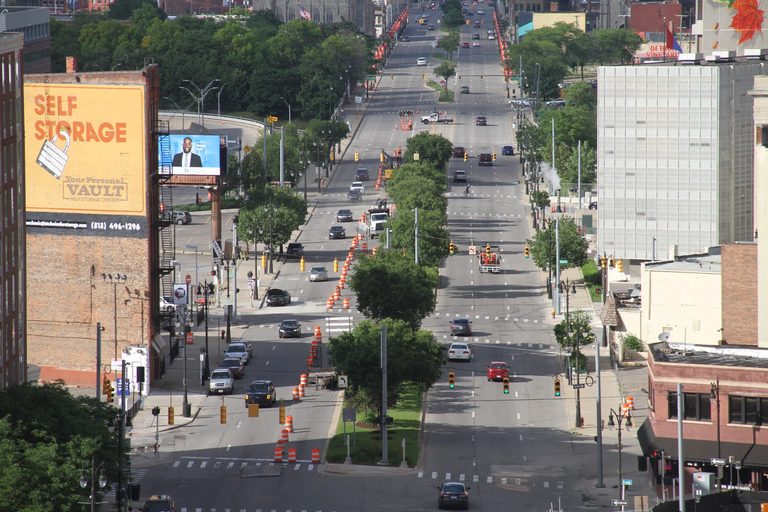
Detroit’s Vision Zero resolution, adopted in 2022, aims to eliminate all traffic fatalities and severe injuries. The council’s latest request reinforces that commitment by focusing on Gratiot Avenue, a 120‑foot‑wide thoroughfare that carries three vehicle lanes in each direction, a center turn lane and curbside parking. The corridor is part of the city’s High Injury Network, a short stretch of streets responsible for 34% of serious crashes despite representing only 3% of the road system.
From Eight Mile to Randolph near Greektown, the segment recorded over 2,500 crashes, nearly 40 fatalities and more than 1,200 injuries between 2019 and 2023. A $12.5 million Safe Streets for All grant from the U.S. Department of Transportation and the Michigan Infrastructure Office was awarded last year, though the grant’s terms prevent the city from removing lanes or reducing traffic capacity.
Challenges from Federal Funding Policies
Council Member Johnson noted that the Trump administration’s Safe Streets and Roads for All program makes it harder for municipalities to secure funding for projects that reduce lane capacity. While “road diets” are recognized as a safety tool by the U.S. Department of Transportation, current federal guidance limits the use of grant dollars for such measures.
“We have dollars available to calm traffic on other Detroit streets, but we need the federal administration to allow those funds to be used for Gratiot,” Johnson said.
MDOT’s Response
MDOT Metro Region spokesperson Diane Cross said the agency is already “actively working” with Detroit and the Suburban Mobility Authority for Regional Transportation (SMART) on safety improvements. She highlighted a planned 2033 reconstruction project for the M‑3/Gratiot corridor, which will create an opportunity to incorporate Complete Streets elements such as shorter pedestrian crossing distances and enhanced bus stops.
Cross also pointed out that the Gratiot corridor is designated as a truck route, and any reduction in lane capacity could divert trucks into residential neighborhoods. She emphasized that MDOT relies on the Detroit Police Department to enforce speed limits and address jaywalking, as MDOT is not an enforcement agency.
Next Steps
The council also expanded the resolution’s recipients to include the Federal Highway Administration and Detroit’s federal representatives—U.S. Senators Gary Peters and Elissa Slotkin, as well as U.S. Representatives Rashida Tlaib and Shri Thanedar—seeking broader support for the safety initiative.
With the resolution now on record, Detroit officials hope that a coordinated effort between city, state and federal partners will bring the needed design changes to Gratiot Avenue, making the corridor safer for families, commuters and the broader community.
Original reporting: BridgeDetroit — read the source article.