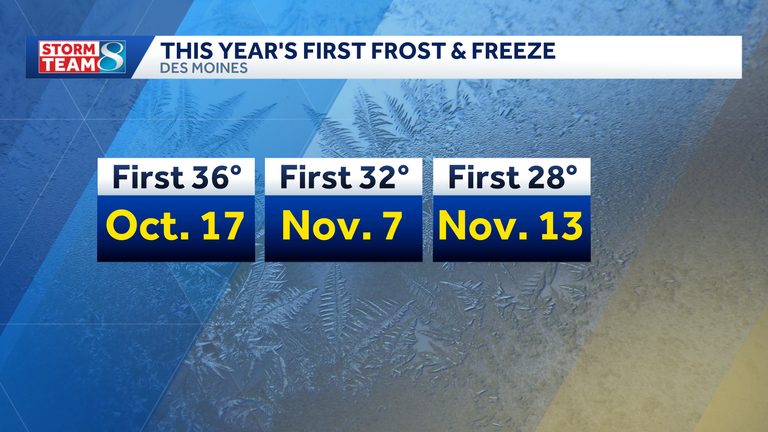
Early Friday morning, residents across central Iowa awoke to a crisp chill as temperatures fell below 28°F for the first time this season. In Des Moines, the thermometer dipped to 25°F, officially signaling the area’s first hard freeze.
What defines a hard freeze?
A hard freeze is defined by meteorologists as a temperature of 28 degrees Fahrenheit or colder. While a regular freeze occurs when temperatures drop below 32°F, the hard freeze threshold is more severe and can have greater impacts on agriculture, landscaping, and outdoor activities.
How this year’s timing compares
Historically, the median date for Des Moines’ first hard freeze is Oct. 28. This year’s hard freeze arrived more than two weeks later, making it one of the ten latest on record dating back to the 1870s. The most recent comparable late hard freeze occurred on Nov. 13, 2026, and prior late dates include Nov. 22, 2024, and Nov. 26, 2009.
Both the first freeze (below 32°F) and the first hard freeze (below 28°F) for 2026 rank among the ten latest occurrences in the city’s long‑term climate record.
Historical context
Below is a list of the ten latest hard freezes recorded in Des Moines:
- Nov. 13, 2026
- Nov. 26, 2009
- Nov. 22, 2024
- Nov. 20, 2015
- Nov. 19, 2016
- Nov. 17, 1902
- Nov. 16, 1982
- Nov. 14, 1881
- Nov. 14, 1970 (tied for 7th)
- Nov. 14, 1978 (tied for 7th)
For regular freezes (below 32°F), the ten latest dates include:
- Nov. 7, 2026 (tied for 4th)
- Nov. 13, 2015
- Nov. 12, 2016
- Nov. 11, 1882
- Nov. 7, 1900
- Nov. 7, 1924 (tied for 4th)
- Nov. 7, 1947 (tied for 4th)
- Nov. 7, 1956 (tied for 4th)
- Nov. 6, 1940
- Nov. 4, 1931
What this means for residents
Later‑season hard freezes can provide a short reprieve for gardeners and farmers, allowing a few extra weeks for crops and ornamental plants to mature before winter damage sets in. However, once temperatures dip below the hard‑freeze threshold, protective measures such as covering tender plants, draining irrigation systems, and securing outdoor equipment become essential.
Local extension services recommend that homeowners and growers take advantage of the delayed freeze by completing any remaining planting or pruning tasks, but also prepare for the inevitable cold snap by insulating water lines and storing outdoor furniture.
Looking ahead
While this year’s hard freeze arrived later than average, climate patterns continue to shift, and future seasons may see further variations in freeze timing. Residents are encouraged to stay tuned to the National Weather Service and local forecasts for updates on upcoming cold weather events.
Original reporting: KCCI Des Moines — read the source article.