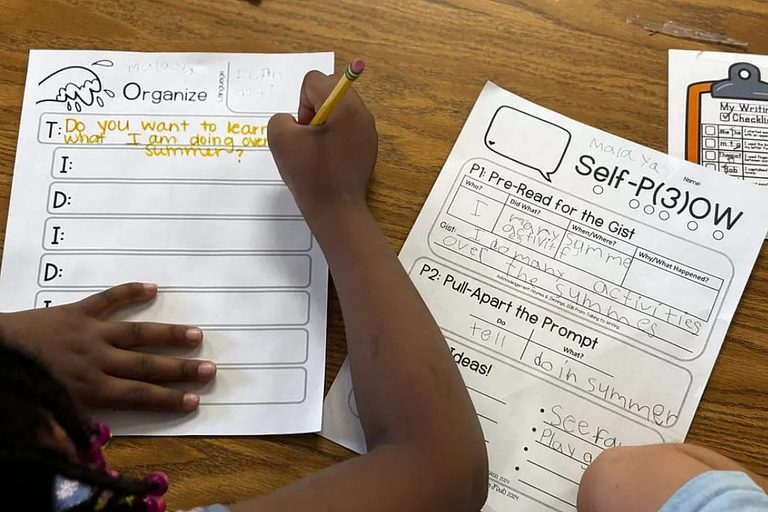
In a first‑grade classroom at Sand Creek Elementary in suburban Denver, students are already drafting paragraphs about their summer plans. Six‑year‑old Dean finished his worksheet before the bell rang, proudly showing a complete topic sentence and a list of activities.
Local teachers report rapid progress
Grace says that at the start of the year many of her students could not write a single sentence. “Now they do this on their own,” she said. “Their writing is very organized, they write in complete sentences, it’s just like clockwork.”
Dean’s confidence reflects a broader shift. Across the nation, educators have long struggled with low writing scores, but districts such as Douglas County, Colorado, are investing in professional development that emphasizes evidence‑based writing strategies.
Statewide and national context
While national data on elementary writing is limited, the last nationwide figures from 2002 showed only 27 % of fourth‑graders scoring proficient. Recent state results paint a concerning picture: in 2025, more than half of Texas third‑graders earned no credit on an essay prompt, and only 17 % of California third‑graders met standards for well‑organized writing.
Experts say the challenges are multifaceted. Writing demands background knowledge, fine motor skills, vocabulary, and executive‑function abilities. “Writing is the hardest thing to teach,” said Chrissy Everett, a fourth‑grade teacher with 23 years of experience in Douglas County.
Research‑backed approaches gaining traction
Educators are turning to the “science of writing,” a research‑based framework that stresses daily writing time, explicit instruction in handwriting, spelling, and vocabulary, and systematic teaching of sentence structure. Associate professor Adrea Truckenmiller of Michigan State University notes that students must first learn that a complete sentence contains a subject and a verb, then how to combine ideas before tackling essays.
Douglas County officials discovered that many teachers lacked a consistent method for teaching writing. Literacy coordinator Janet Merrill recalled that teachers often relied on ad‑hoc resources from online marketplaces, resulting in varied and sometimes random writing assignments.
To address this, the district adopted Self‑Regulated Strategy Development (SRSD), a prescriptive approach that guides students to use evidence from texts and follow clear planning steps. Merrill says the shift has already yielded more organized student work.
Implications for families and faith‑centered communities
Strong writing skills are essential for parental‑rights advocates who emphasize the role of families in education. When children can express themselves clearly, they are better prepared for higher education and the workforce, aligning with the values of traditional families and faith‑based communities.
As Denver schools continue to refine their curricula, early successes like Dean’s illustrate the potential of focused, evidence‑based instruction to restore confidence in elementary literacy.
Original reporting: KEYT (Ventura/Santa Barbara) — read the source article.