Long before Jacksonville’s Westside became synonymous with warehouses and distribution centers, a single developer saw opportunity in an overlooked stretch of land along Dennis Street. His gamble transformed a quiet corridor into one of the city’s most important industrial districts.
Early Development
In the early 1940s, Dennis Street looked nothing like it does today. When John E. Price acquired property along the west side of Dennis Street near Stockton Street just before World War II, only three industrial facilities lined the roadway: Atlantic Ice & Coal Co., Swift & Co. and an aging mattress factory.
Following the war, Price began turning his vision into reality. In 1946, bulldozers moved onto the property as crews filled marsh along McCoys Creek, graded the land, laid out new streets, and installed Atlantic Coast Line Railroad sidings down the middle of Harper and Swan Streets.
Industrial Growth
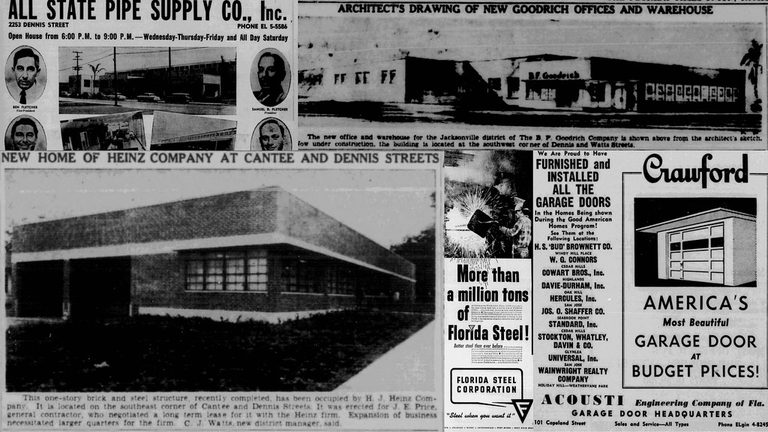
Within three years, 25 companies had established operations in the emerging Dennis Street Industrial District. Price’s first major success came in 1947 when Turpentine Rosin Factors, Inc. signed a contract for a new $100,000 warehouse serving the company’s commissary operations.
As word spread, nationally recognized companies began selecting Dennis Street for regional distribution operations. Jewel Tea Co., an Illinois-based door-to-door grocery and housewares business, established operations in 1948.
By 1949, development accelerated dramatically. B.F. Goodrich relocated from Downtown Jacksonville to a modern 18,800-square-foot warehouse at Dennis and Watts streets.
Legacy
The success of the Dennis Street Distribution District did not happen by accident. It resulted from the foresight of John E. Price, who recognized the area’s location was strategically positioned for distribution facilities due to its access to West Jacksonville’s rail infrastructure.
Original reporting: Jacksonville Today — read the source article.