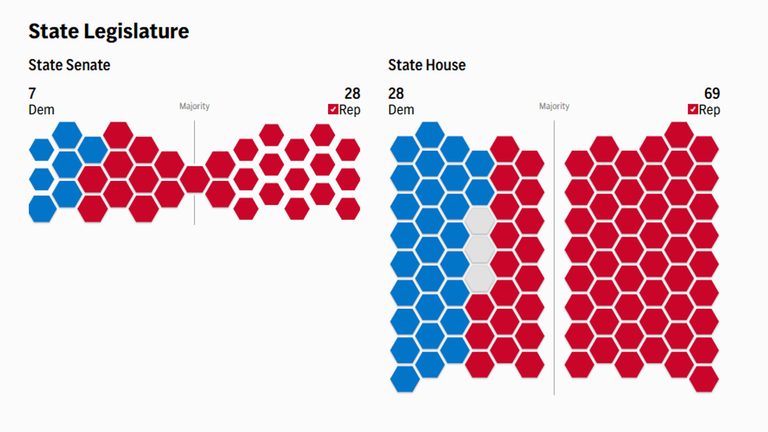
Tuesday’s election night tally indicates a notable shift in the Arkansas House of Representatives. While Republicans still hold a commanding 72 seats, Democrats have captured seven additional seats, bringing their total to 28. In the state Senate, the preliminary count shows Republicans with 28 seats and Democrats with seven.
Implications for the state budget
The most consequential change comes from the House composition. Under the Arkansas Constitution, a three‑fourths vote—75 percent of the chamber—is required to approve appropriations that exceed the state spending limit, except for certain categories such as education and highways. With 72 seats, Republicans now fall short of that supermajority threshold.
Because the GOP no longer controls three‑fourths of the House, they may need to negotiate with Democratic members to secure the votes needed for some spending bills that exceed the limit. This could lead to more bipartisan discussion on budget priorities, especially for programs that do not fall under the education or highway exemptions.
Senate remains solidly Republican
The Senate’s preliminary 28‑7 split still gives Republicans enough seats to meet the three‑fourths requirement on their own, assuming party unity. Consequently, the Senate is likely to continue advancing its agenda without needing Democratic support, while the House may see more cross‑aisle collaboration.
Election results still pending certification
County election commissions must still canvass and certify the returns before the Secretary of State can officially certify the results. Until that process is complete, the numbers remain unofficial, but the current figures already suggest a meaningful change in the balance of power.
Even if the final count mirrors the preliminary tally, Democrats will not gain control of the House or the budget. However, the loss of a supermajority could affect which appropriations can pass without bipartisan backing, potentially reshaping the legislative strategy for the upcoming fiscal year.
What’s next for Arkansas lawmakers?
Legislators on both sides will likely begin early discussions on how to navigate the new dynamics. Republican leaders may seek to build coalitions around shared priorities, while Democratic members could leverage their increased presence to influence key spending decisions. The upcoming budget negotiations will be closely watched by constituents who care about responsible fiscal stewardship and the efficient delivery of public services.
Arkansas voters will have the opportunity to see how their elected officials respond to this shift when the General Assembly reconvenes in early 2027. The balance of power in the House may set the tone for future elections, as both parties assess the impact of these newly won seats on state policy and governance.
Original reporting: KATV Little Rock (local) — read the source article.