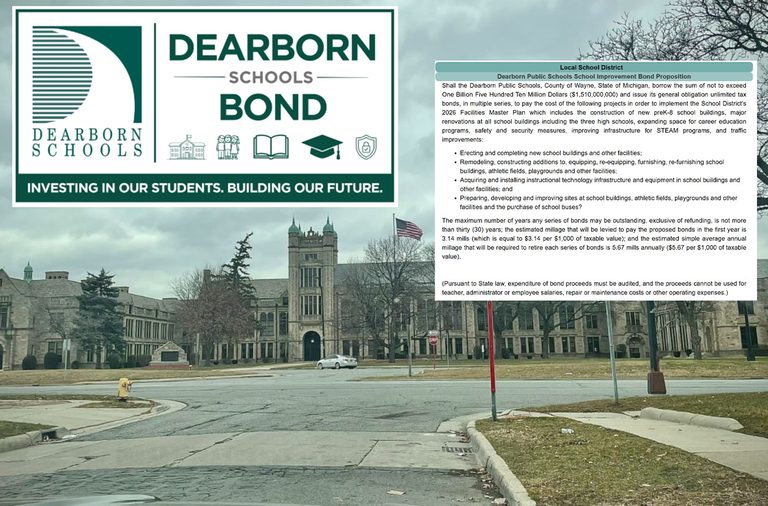
Residents of Dearborn and the northern portion of Dearborn Heights will head to the polls on November 3 to decide on a $1.5 billion “transformational” bond proposal from Dearborn Public Schools. The measure, if approved, would fund a 20‑year, four‑phase plan to renovate existing schools, construct new pre‑K‑8 buildings, improve safety and security, expand career‑education spaces and add dedicated STEAM learning areas.
How the financing works
The bond would be repaid over roughly 30 years with an initial millage of 3.14 mills – that is, $3.14 per $1,000 of taxable property value. The district estimates the average annual millage needed to retire the bonds at 5.67 mills. Proponents argue that the net impact on homeowners will be negligible because two millage reductions are expected to offset the increase.
First, the district plans to eliminate a 2.18‑mill operating millage if the bond passes, effectively stopping collection of that levy. Second, a separate 0.96‑mill reduction will come from the combined sewer overflow project, which is ending regardless of the bond outcome. Those two cuts total 3.14 mills – the same amount of the new bond levy – meaning most taxpayers should see no change in their school‑related property taxes.
Impact on Dearborn Heights residents
Dearborn Heights homeowners who fall within the Dearborn Public Schools boundary will experience a different calculation. Because they have not been paying the sewer‑overflow millage that the rest of the district will lose, they will see a net increase of 0.96 mills in school‑related taxes. For an average home, that translates to a modest rise in the annual tax bill.
Timeline and expectations
The district says students could begin seeing improvements within three years of bond approval, while the full suite of projects would be completed over the 20‑year span. Each phase will prioritize the most urgent needs, and the district has pledged to seek community input before moving forward with each stage.
Key components of the plan include:
- Construction of new pre‑K‑8 school buildings.
- Major renovations at all existing schools, including the three high schools.
- Expansion of career‑education and STEAM facilities.
- Upgrades to safety and security systems.
- Traffic‑flow improvements around school sites.
What voters need to know
When evaluating the bond, voters should consider both the promised upgrades and the financing details. A mill represents $1 of tax for every $1,000 of a property’s taxable value – not the market value of the home. Homeowners can calculate their potential contribution by multiplying their taxable value by the mill rate and dividing by 1,000.
For those who want more information, the full bond language and a detailed breakdown of the projects are available on the Dearborn Public Schools website.
Context
School bonds are a common tool for districts across Michigan to fund capital projects without dipping into operating budgets. The proposed bond aligns with the district’s 2026 Facilities Master Plan, which was developed after extensive community outreach and a review of long‑term infrastructure needs.
As the election approaches, both the school district and local media are encouraging residents to review the bond details, attend informational sessions and consider how the proposed improvements will affect the quality of education for Dearborn’s children.
Original reporting: Warren | FOX 2 Detroit — read the source article.