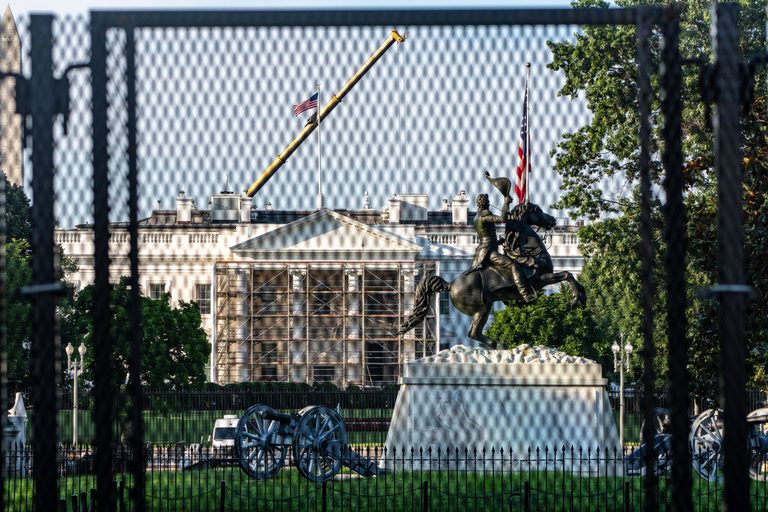
The National Capital Planning Commission voted Thursday to advance President Donald Trump’s plan to erect a permanent fence around Lafayette Park in Washington, D.C. The vote was 7‑1, with only one commissioner dissenting.
Local officials and public testimony
Commission members heard testimony from seven local residents who opposed the project, warning that a fence could create a barrier between Americans and their government at a time when the right to gather and speak is vital. Retired NPR White House reporter Pam Fessler warned that the fence would “close the gates” and limit free expression.
Attorney Laura Follansbee of the American Civil Liberties Union of D.C. argued the fence could restrict First Amendment rights, noting Lafayette Square’s historic role as a protest gathering place next to the White House.
Commission response
Commission Chairman Mark Paoletta, a Trump appointee, rejected the notion that a fence would erase constitutional freedoms, stating, “I don’t accept the idea that a fence means we lose our First Amendment rights.” He emphasized the security rationale, citing a Secret Service assessment that linked recent shootings near the White House and assassination attempts on the president to the need for permanent fencing.
Paoletta added, “The Secret Service has been asking for something like this for 12 years. I don’t want to lose the momentum. The status quo cannot continue, in my view.” The plan calls for an eight‑foot fence with large gates at the north and south entrances, based on a 79‑page security study.
Opposition from a commissioner
Evan Cash, representing the D.C. City Council on the commission, cast the lone dissenting vote. He described the proposal as “security theater” that inflates risk to discourage peaceful protest.
Additional commission actions
Alongside the fence approval, the commission authorized an underground visitor‑screening center for the White House, to replace temporary tents with a permanent 33,000‑square‑foot facility beneath Sherman Park. The commission also transferred jurisdiction of the D.C. Armory site—part of the future $3.1 billion stadium complex for the Washington Commanders—to the District, and moved several Georgetown Waterfront parcels to expand public access.
Implications for the community
The decision underscores the Trump administration’s focus on securing the nation’s capital while balancing constitutional freedoms. Local residents and civil‑rights advocates will continue to monitor how the fence and related security measures affect public gatherings in the heart of the nation’s capital.
Original reporting: Alexandria, VA News – WTOP News — read the source article.