The headline and opening excerpt center a personal family story within a wider act of communal remembrance. They highlight Anna Salton Eisen’s discovery of a black-and-white photograph of her mother with children after the Holocaust, and they link that discovery to a public observance during Yom HaShoah. Together, the title and excerpt signal both a personal quest to understand a parent’s past and a community ritual devoted to memory and honoring victims and rescuers.
Anna Salton Eisen described first seeing a photograph of her mother, Ruth Salton, standing at the edge of a forest surrounded by children who had survived hiding during World War II. The image raised immediate questions for her: Who were those children, and what role had her mother played in their lives? Like many children of survivors, Anna said she only pieced together much of her parents’ wartime experiences later in life.
Through years of research and two books, Salton Eisen reconstructed the story behind the photo. Her mother worked to help Jewish orphans who had been hidden during the war, moving them across Polish borders and into displaced persons camps in Germany, Austria and Italy. After the fighting ended, Ruth Salton joined organized efforts to reunite or relocate children who’d been separated from their families, part of a larger, clandestine network sometimes called the Bricha.
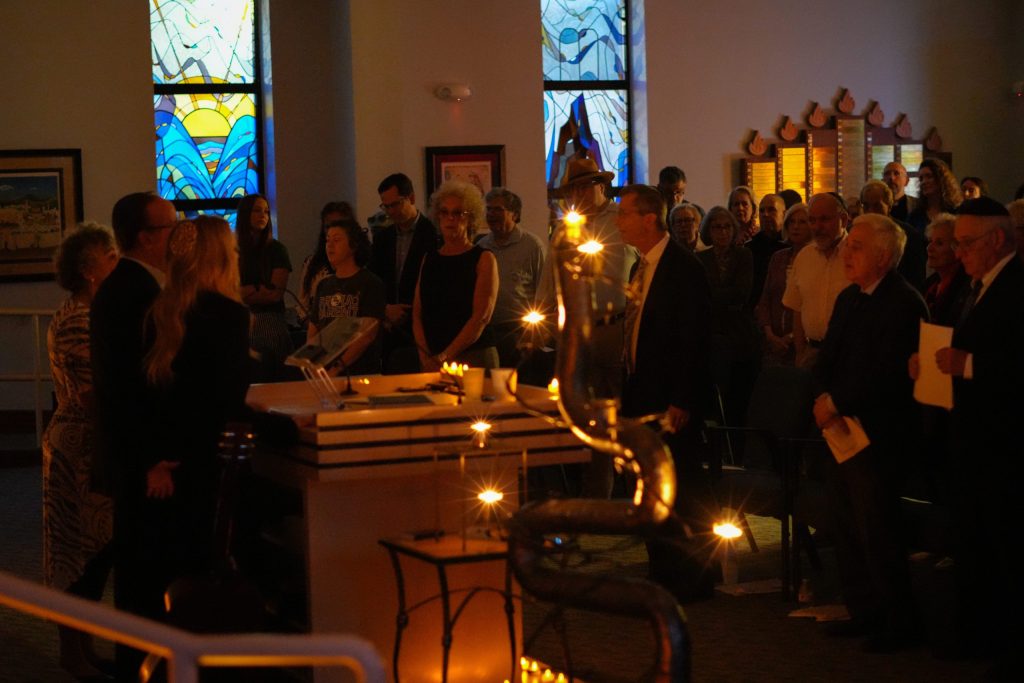
The family account was shared at a local synagogue during a Yom HaShoah (Holocaust Remembrance Day) observance. The service was quiet and reflective: a cantor played a guitar and led a lamenting song, communal prayers and readings honored those who died and those who survived, and candles were lit from a menorah entwined with barbed wire to symbolize suffering and resistance. Speakers emphasized that while the past cannot be changed, remembering can shape the future and keep victims’ and rescuers’ stories alive.
Speakers also placed Ruth Salton’s work in a broader context of rescue efforts. They recalled figures such as Irena Sendler, a Polish Catholic social worker who entered the Warsaw Ghetto, helped smuggle children out and hid them in orphanages, convents and private homes. Sendler and others gave many children new identities and kept records—often encoded—so that families who survived might one day reclaim them.
The commemoration noted why Yom HaShoah falls in April: it aligns with the anniversary of the 1943 Warsaw Ghetto Uprising, a moment of resistance amid terrible conditions. In Warsaw, more than 400,000 Jewish residents were confined to a small area, where overcrowding, lack of food and disease led to mass suffering and death. Those conditions are part of the historical backdrop for the rescue and recovery efforts described by Salton Eisen.
Looking at her mother’s photograph now, Salton Eisen said she sees not only loss but also purpose: a young woman who set aside personal plans to help reclaim children left orphaned by war. The ceremony’s message was that remembering these acts of courage—by both rescuers and survivors—keeps their legacies alive and connects present-day families to the stories of the past.